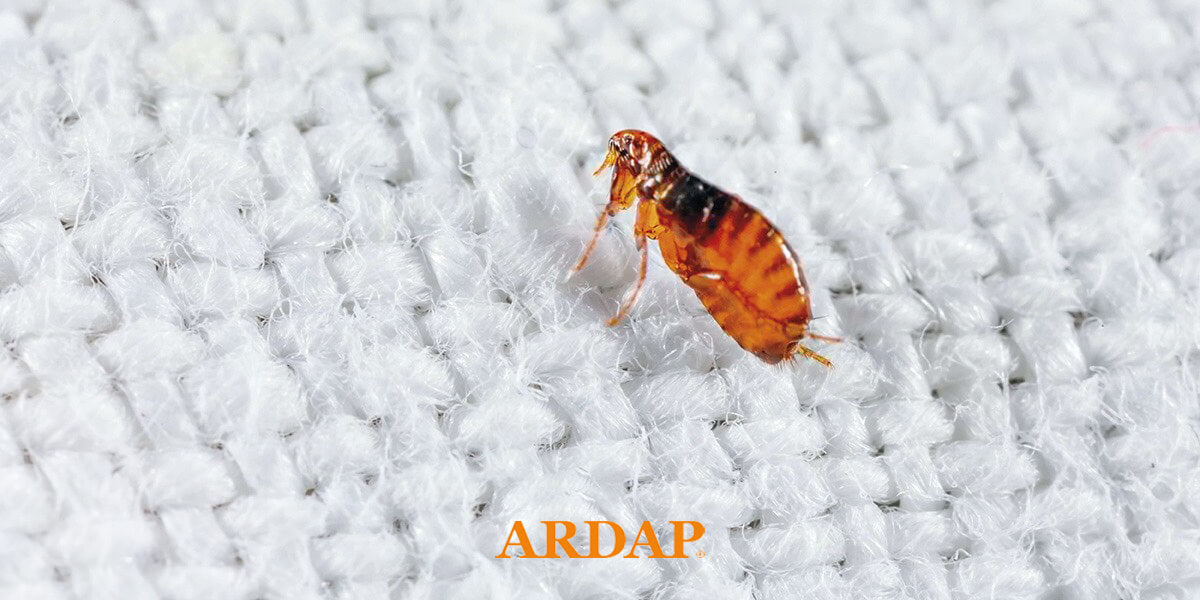
Together with our expert Prof. Dr. med. vet. Norbert Mencke, a specialist veterinarian in parasitology, we will show you the flea life cycle as well as effective flea treatments. You will also learn why, when controlling fleas, you must treat not only the cat and dog but also their environment.
- The Flea Life Cycle
- Fleas Are Survival Experts
- Eliminate and Prevent Flea Infestations Long-Term
- Conclusion
- Frequently Asked Questions
Complex life cycle in the environment: Flea females lay an average of 27 eggs daily in the fur of dogs or cats. These fall out unnoticed and spread throughout the home (beds, carpets, crevices).
Enormous endurance in the pupal stage: In their protective pupal casing, fleas can survive for up to 6 months without food in the environment until a vibration or heat stimulus triggers the sudden hatching of the flea.
Long life expectancy of adult fleas: An adult flea can survive for up to 40 days after hatching without a host or blood meal. If it finds a host animal, it can live for up to 133 days.
Humans as accidental hosts: Although fleas use humans as a blood source in cases of heavy infestation (flea bites), they can hardly hold on to human skin, are washed off during showering, and cannot reproduce without suitable host blood.
Living spaces offer an optimal year-round climate: Heated homes provide fleas with perfect living conditions at all times of the year, which is why it is "flea season" all year round for pet owners.
Simultaneous treatment is essential: Since the vast majority (95%) of the flea population (eggs, larvae, pupae) lives in the environment, treating only the animal is ineffective. Both the animal and the environment must always be treated with the appropriate, highly effective ARDAP products.

The Flea Life Cycle
Fleas go through several stages in their development: The female first lays eggs, in which the flea larvae develop. Flea eggs are oval and slightly transparent at first, with a later ivory-colored surface. However, the eggs are barely visible to the naked eye, as they are only about 0.5 mm x 0.3 mm in size.
The flea larva develops through three larval stages. In the third larval stage, the larvae are about 4-5 mm long. Then the larvae pupate and remain in a protective "pupal dormancy," waiting for a suitable host. Various external stimuli, such as vibrations or the body temperature of your cat or dog, trigger the rapid hatching of the adult fleas. The newly hatched flea then leaves its pupa and uses its powerful jumping ability to jump onto its host.

Cat and dog fleas always lay their eggs on their host animals. However, because flea eggs - unlike, for example, lice nits - do not stick to hair, the flea eggs fall out of the animal's fur together with the flea droppings. Places where many flea eggs are commonly found include beds and sleeping areas in living spaces, as well as carpets, upholstery, and floor crevices. Unnoticed and untreated, the flea eggs can develop through the larval stages into pupae and eventually into adult fleas.
How do fleas reproduce?
After mating, the female flea sucks blood from a host (dog, cat, human, etc.) and then produces an average of 27 eggs per day, which are laid in the host's fur. When the animal moves, the flea eggs fall out of the animal's fur and spread throughout the home.

Female fleas lay their first flea eggs just 24 to 36 hours after their first blood meal.
The larvae that develop from them feed mainly on the droppings of adult fleas, which contain large amounts of undigested blood. Under optimal conditions, flea larvae begin pupating after about two weeks.

Living conditions for fleas
Fleas develop both in the home and outdoors and can be found anywhere potential hosts such as dogs or cats, but also wild animals such as hedgehogs or birds, stay. To prevent your pet and your home from becoming infested with fleas, it is best to prevent infestation and the introduction of parasites.
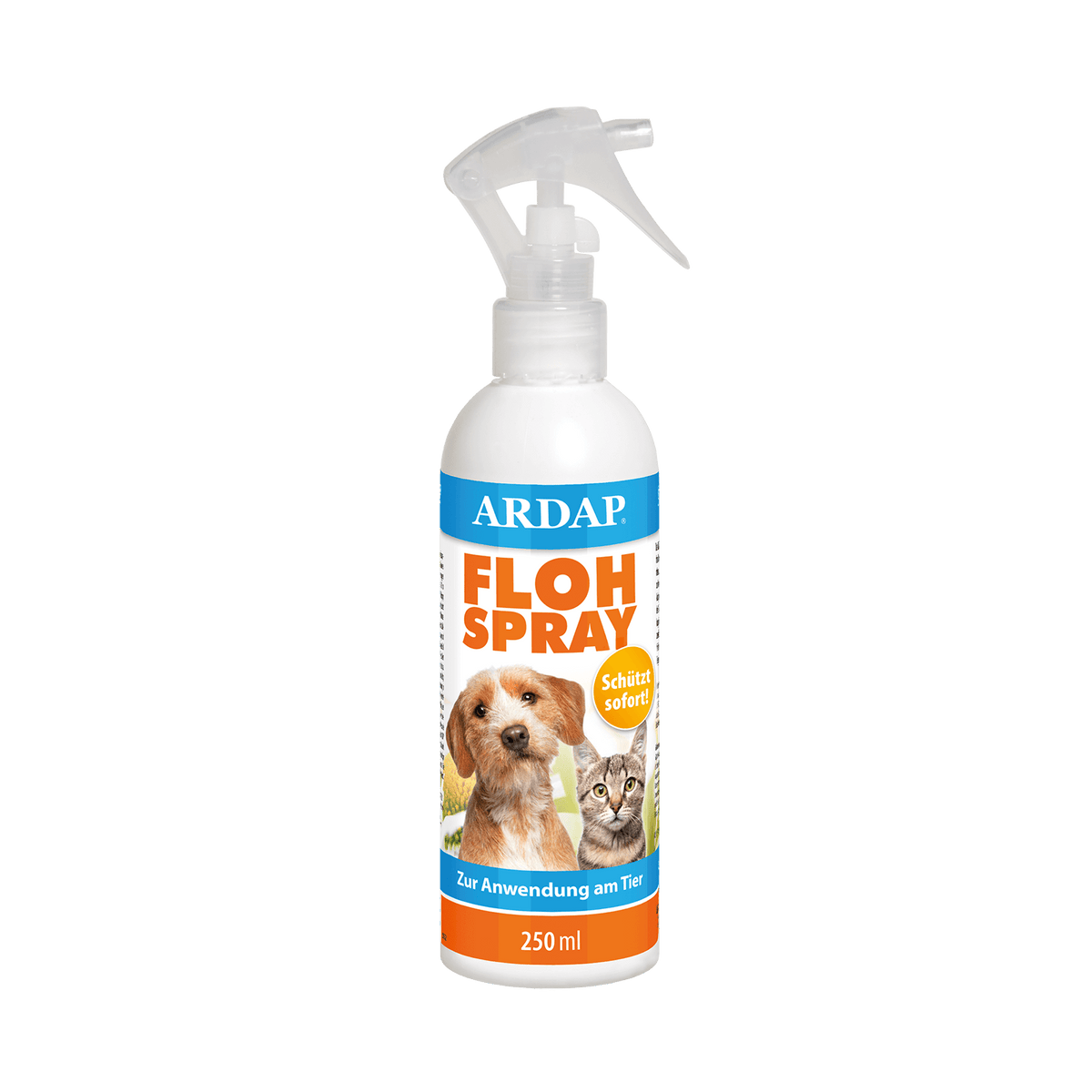
For this purpose, repellent products based on pyrethrum (Chrysanthemum cinerariaefolium) are suitable: The ARDAP flea collar for cats or flea collar for dogs provides protection for up to 4 months, while the ARDAP Spot-On provides reliable repellent action for up to 12 weeks. For targeted use on particularly vulnerable areas such as the back, base of the tail, or belly, flea spray, flea powder, and flea shampoo from ARDAP are also available for use on the animal.
For flea repellent in the environment, e.g. on doormats or beds, the Repell Flea Spray is suitable.

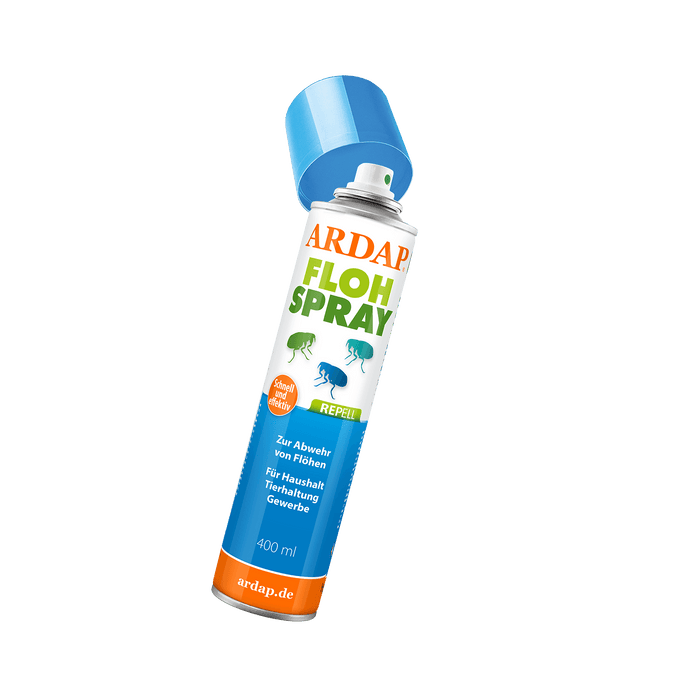
Step-by-step instructions: How to use the ARDAP Repell Flea Spray correctly:
- Step 1: Preparation – Shake the spray can thoroughly before use. Make sure that aquariums and terrariums in the room are well covered and keep cats away during the entire spraying process.
- Step 2: Spraying – Treat the resting and hiding places preferred by fleas in well-ventilated rooms. Spray the surfaces specifically until they are slightly damp (but not wet). As a guideline, a two-meter stretch is sprayed for about one second (equivalent to approx. 1.5 g of product).
- Step 3: Post-treatment & Ventilation - Ventilate the treated indoor spaces thoroughly after use until no product odor can be detected. The room can be entered again during ventilation.
Recognizing and treating flea infestations
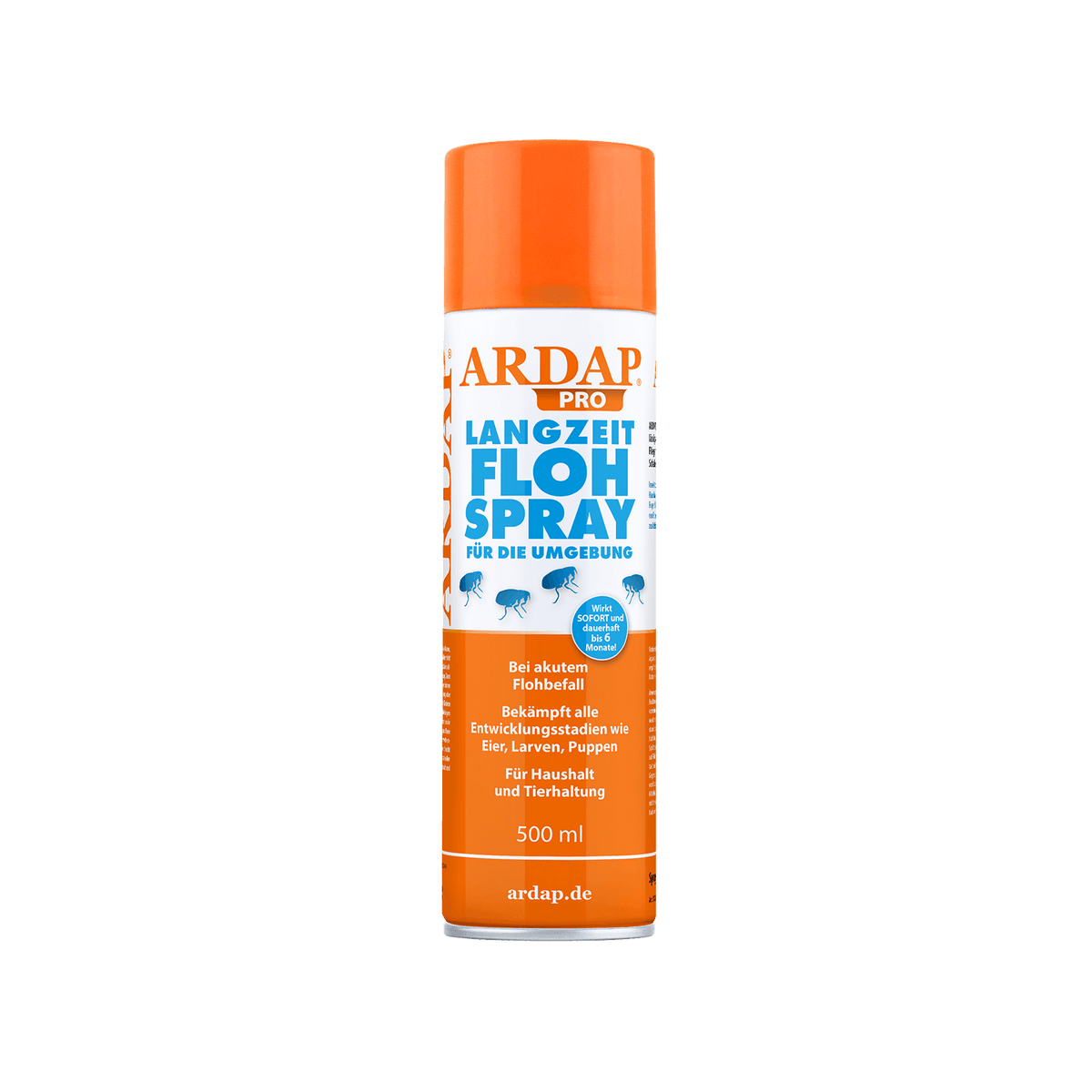
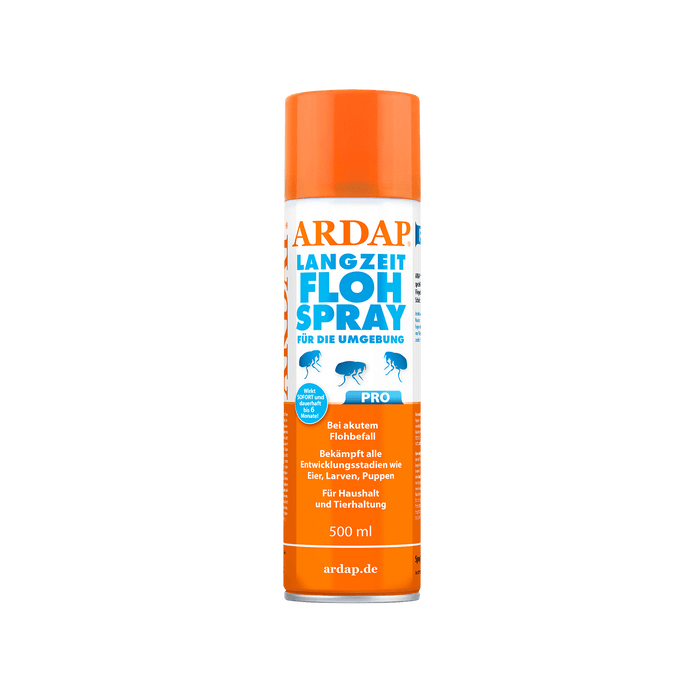
If you suspect a flea infestation, it is essential to treat it. Products for environmental treatment, such as the ARDAP Pro Long-Lasting Flea Spray or the ARDAP Pro Fogger, contain a so-called growth inhibitor. This interrupts the flea life cycle, so that in addition to adult fleas, eggs, larvae, and pupae can also be controlled.
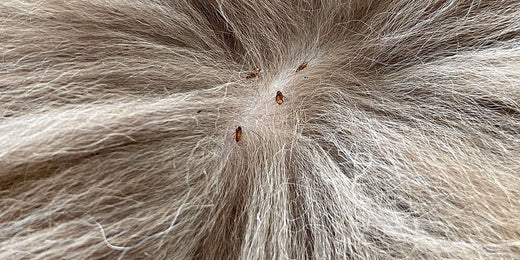
Regular combing with the fine-toothed flea comb helps detect flea droppings. These are recognizable as small brown-red granules.
Have you found small, dark dots in the fur or in the home and are not sure whether they are dirt or flea droppings? Take a tissue or some kitchen paper and dampen it. Collect the dots on the tissue and try to crush them. If the dots can be crushed and the tissue turns red to brown at the spots, it is blood and therefore flea droppings. Treatment of pets and the environment is then essential.
Fleas Are Survival Experts
Fleas are true survival experts. They can spread rapidly unnoticed and untreated. How long the individual developmental stages actually survive can be found in the following sections.
How long can a flea survive without food?
Adult fleas can survive for about 40 days without a blood meal, while the flea pupa in its cocoon can survive for up to six months without food. However, for the flea pupa to survive without food, the environment must be warm enough. Fleas feel very comfortable at room temperature, which is why it is always flea season for pet owners.
How long do fleas survive on humans?
Cat fleas, which also infest dogs, are the most common type of flea in this country. If you do not prevent flea infestations and do not stop its further spread in time in the event of an infestation, you will sooner or later have flea bites yourself, often mistakenly also called flea bites. Fleas can also infest humans, but they need the blood of their host animal to reproduce. Fleas usually cannot survive for long on humans. Unlike dogs and cats, fleas have hardly any chance of holding on to human skin and hair. A shower washes off fleas that do find their way onto the human body.
Fleas on humans are usually the result of a heavy flea infestation in a cat or dog. In such cases, the pets must be treated with repellent products and the environment must be treated consistently.
Flea bite or flea bite?
Colloquially, people often speak of a "flea bite." However, medically and parasitologically, they are flea bites. Fleas have piercing-sucking mouthparts with which they pierce the skin to get to the blood.

How long do fleas survive in the home?
Cozy heated homes offer optimal living conditions for fleas. Once they are there and are not actively controlled, dog and cat fleas can survive for a long time in the home and reproduce.
An adult flea can survive for up to 40 days without a host and blood meal after hatching. However, if the flea finds a host, it can survive on it for up to 133 days.
With the Pro Long-Lasting Flea Spray, beds, scratching posts, and similar items can be targeted for spraying - for a long-lasting effect of up to 6 months. In addition, a Pro Fogger can be used in rooms of up to 60m². The fogger is activated at the push of a button and thus ensures the fogging of the rooms. The fine spray mist then spreads throughout the room and, thanks to the growth inhibitor contained, works against fleas as well as their eggs, larvae, and pupae for up to 6 months.
Eliminate and Prevent Flea Infestations Long-Term
Often, a large part of the flea infestation remains undetected or is discovered too late. To eliminate a flea infestation and prevent it permanently, not individual fleas, but the entire flea population in its various developmental stages must be removed.

For immediate measures against fleas, products for environmental treatment are needed, such as the Pro Long-Lasting Flea Spray for the environment and the Pro Flea Fogger. If animals live in the household, the flea infestation on the animal must also be treated. To avoid a flea infestation, repellent products for use on the animal or for the environment based on pyrethrum are necessary.
Conclusion
A flea infestation is always persistent because fleas are true survival experts: The majority of the population hides unnoticed as an egg, larva, or pupa in the home, long before you discover the first adult flea. That is exactly why treating only the pet is insufficient. Only when you treat the animal and the environment at the same time is the life cycle of the parasites actually broken and the flea infestation permanently controlled.
Therefore, take a two-pronged approach: Protect your pet preventively from a new infestation with a collar or Spot-On from ARDAP. At the same time, target an existing flea infestation in all developmental stages throughout the entire environment with the ARDAP Pro Long-Lasting Flea Spray and the ARDAP Pro Fogger. By applying consistently, you ensure a permanently flea-free and relaxed home.
Frequently Asked Questions
How long do fleas live in the home?
Fleas can survive in the home for several months, as they find optimal conditions in comfortably heated living spaces all year round. If they are not actively controlled, they do not die off on their own but multiply rapidly. The pupal stage is particularly resilient: a flea pupa can wait in its protective cocoon in carpets, sofa crevices, or a dog bed for up to 6 months without food for a host. To control all stages of the flea life cycle throughout the home, the ARDAP Pro Fogger in combination with the ARDAP Pro Long-Lasting Flea Spray is ideal for targeted supplementary treatment of fleas' favorite hiding places.
How long do fleas live on humans?
Since human skin and hair offer little grip for fleas, they usually only survive or stay on us for a few hours or days. They are often simply washed away at the next shower. Although fleas can transfer to humans and cause painful bites, humans are considered "accidental hosts". Furthermore, dog and cat fleas cannot reproduce without the blood of their primary hosts. If fleas transfer to humans, it is usually due to a very heavy infestation of the pet or its resting places. Treat the preferred textiles (e.g. the bed or sofa) preventively with the ARDAP Repell Flea Spray to repel the parasites. At the same time, ARDAP Products for Use on Animals prevent infestation on your pet, meaning that fleas are never brought into your home in the first place and cannot infest humans either.
Why does flea infestation keep reappearing despite treating the animal?
A common reason why flea infestation keeps reappearing despite treating the animal is that the environment has not been treated as well. However, the majority of the flea population (95%) is found there as eggs, larvae, or pupae. Many people use home remedies such as essential oils or vinegar for environmental treatment in the event of a flea infestation. They are supposed to keep fleas away, but they cannot control an existing infestation. In the event of an acute flea infestation, it is essential to treat the environment with highly effective and long-lasting products such as the ARDAP Pro Long-Lasting Flea Spray and the ARDAP Pro Fogger. Both products are effective for up to 6 months and control fleas at all stages of their life cycle. At the same time, ARDAP Products for Use on Animals are suitable for protecting the animal against reinfestation. Only in this way can a flea infestation be truly controlled permanently.
Can dogs and cats in the same household infect each other with fleas?
Yes, it is actually common for dogs and cats in the same household to infect each other with fleas: the cat flea, our most common flea species, infests both dogs and cats despite its name. Since fleas and their eggs spread through shared beds, blankets, or sofas, it is not enough to treat only the affected animal. If several pets live in the same household, you should generally treat all pets preventively at the same time and also regularly spray the shared resting places and the environment with the repellent ARDAP Repell Flea Spray.
Do I also need to treat preventively against fleas in winter?
Yes, contrary to popular belief, winter is not a problem for fleas: in heated homes they find ideal conditions all year round, regardless of the outside temperature. If prevention is paused during the colder months or only carried out irregularly, an initially unnoticed residual infestation can spread unchecked. Therefore, use the ARDAP Flea Collar, Spot-On, or ARDAP Repell Flea Spray for the environment continuously all year round instead of interrupting application seasonally.
How long does it take for a new flea to hatch from a flea egg?
Under optimal conditions in the home (warmth and humidity), flea larvae develop into pupae after about two weeks. How quickly the fully formed flea then hatches from the pupa depends on external stimuli: if the pupa senses the body heat or vibrations of a passing animal, the flea hatches within seconds and jumps onto the host. If these stimuli are absent, it remains in its pupal dormancy for up to 6 months.
How can I tell if there are still fleas living in the home?
A sure sign of fleas in the home is flea dirt. Comb your pet with a fine-toothed flea comb and wipe the residue onto a damp kitchen towel. If the small, dark crumbs turn reddish-brown on the towel, it is digested blood (flea dirt). This is the latest point at which the use of ARDAP Pro Products for Use in the Environment is absolutely necessary.
Sources
- Fleas – small bloodsuckers with a big impact – Parasitenportal.de
- Fleas – Umweltbundesamt.de
- Fleas in dogs – ESCCAP.de
- Fleas in cats – ESCCAP.de
- Epidemiological studies on flea infestation in dogs and cats in the Leipzig area – University of Munich
- Studies on the population dynamics of cat fleas – vetline.de
- Flea saliva allergy in dogs and cats – AniCura.de