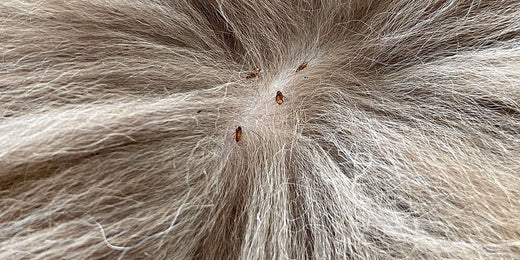
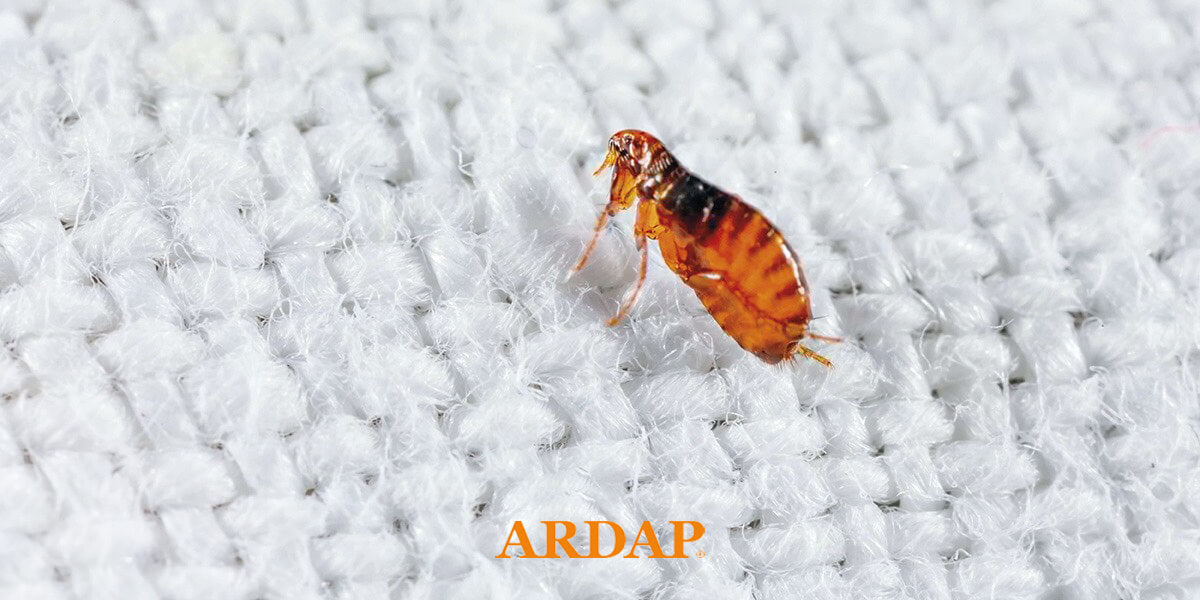
In cooperation with our veterinarian Prof. Dr. med. vet. Norbert Mencke, a specialist in parasitology, we will show you what you can do if mites and fleas occur in cats.
- What are fleas?
- What are mites?
- Distinguishing mites and fleas in cats
- What to do if the cat has fleas?
- Combating cat mites

What are fleas?
Fleas are parasites that feed on the blood of their host. The warm, moist cat fur provides optimal conditions for fleas. One of the typical characteristics of fleas is their rapid spread. Once brought in from outside, fleas can establish themselves anywhere in the home and house in no time. The cat's sleeping area, for example, is particularly often affected. In addition, fleas develop in carpets, cracks in the floor, and everywhere where we can hardly see them. The explosive spread of fleas is due to their rapid egg-laying. A female flea lays an average of 27 eggs a day.
Cats often pick up fleas when they are out and about. If they come into contact with infested wildlife, such as hedgehogs, the cat can become infested. Fleas can also be transmitted indirectly. If a cat stays in an area where an infested hedgehog is present, fleas in the “pupal rest” stage can hatch rapidly and thus jump onto the cat as a host.
Fleas bite to get blood and release saliva in the process, which can cause skin irritation and inflammation. In some cases, allergic reactions occur, known as flea saliva allergy.
How can you detect fleas in cats?
The pupae, larvae, and eggs of fleas are tiny and therefore practically invisible to the naked eye. This raises the question of how you can reliably detect a flea infestation on your cat in the first place. However, some signs clearly indicate a flea infestation, and you must especially check the animals' fur regularly. If you notice small black crumbs when combing the fur with a flea comb, you should examine them more closely. Simply crush them in a damp tissue and see if reddish discolorations appear. In this case, it is the excrement of the parasites. You may also find these crumbs elsewhere in the home, for example on the sofa or on the bed sheet.
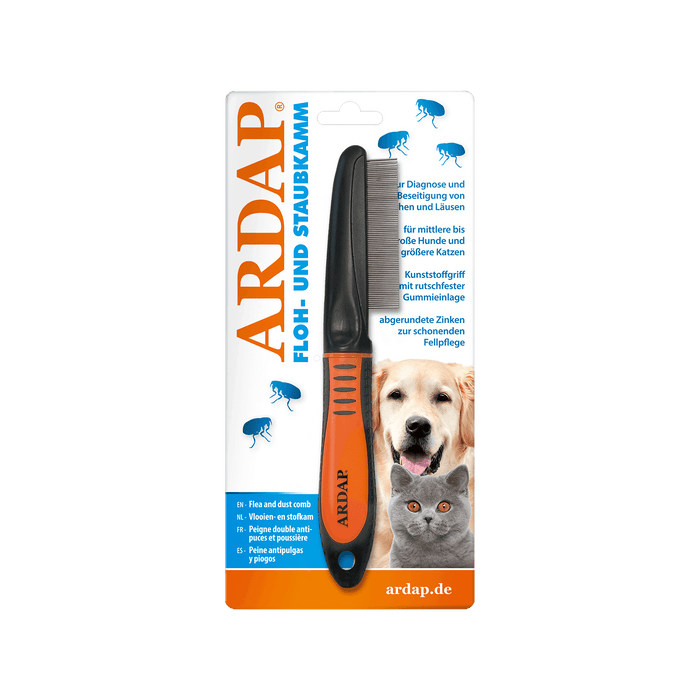
The ARDAP flea and dust comb is ideal for diagnosing and removing fleas and lice. Rounded teeth allow for gentle fur care, while the non-slip handle provides a secure grip.
To the productFleas cause an itchy sensation by biting. In this case, take a closer look at your cat's skin. If you can see red dots and several puncture marks occur directly next to each other, this could indicate flea bites. However, cats do not always show noticeable itching when infested with fleas. Other symptoms can include intense grooming and biting at the puncture marks. The cat may also appear generally more restless and stressed.

What are mites?
Not only do fleas feel comfortable in cat fur, but mites can also infest the cat's skin. Mites are arachnids. In particular, distinctions between these parasites must be taken into account in cats. The vast majority of mite species are free-living in the environment and are not parasitic, i.e., they pose no danger to the health of humans or animals.
Since mites cause skin changes and severe skin irritation, you should take it as a signal if your cat scratches itself frequently. There is a great danger that the cat will scratch itself raw over time and develop serious inflammation. An infection with ear and head mites in cats should always be presented to a veterinarian so that appropriate therapy can be initiated after diagnosis.
What mite species are there?
In this section, we will give you an overview of the mite species that occur most frequently in cats and their main characteristics.
Head mite
With head mites, cats are affected mainly in the head area. However, they can also occur on the neck and, in cases of very severe mange, on other parts of the body. If head mites (Notoedres cati) have infested the cat here, severe itching, skin redness, hair loss, and massive changes in the skin are typical symptoms. These are small, round mites that bore tunnels into the animals' skin and lay their eggs there.
Ear mites
As the name already suggests, these mites infest the ear region of the cat. Contact with other animals can quickly lead to transmission. Young animals are most affected, but ear mites (Otodectes cynotis) can infest cats of any age. In your case, it is always possible that the mites spread from the ears over the entire body of the cat.
Fur mites
Fur mites (Cheyletiella blakei) actually feed on other arachnids, as they belong to the predatory mite species. However, they can also feed on tissue fluid and skin material of a mammal and live on it. Therefore, fur mites also infest cats, but prefer dogs. Transmission usually occurs through direct body contact. Fur mites are highly contagious. It is also possible that transmission occurs through brushing and combing the animals.
Autumn grass mites
This mite species is actually a free-living mite. It only lives parasitically in the larval stage and needs blood for further development. The adult autumn grass mite (Neotrombicula autumnalis) measures between one and two millimeters in length. It lays its eggs in the damp soil, and the larvae then hatch in summer and autumn. If cats stay in an affected garden, for example, they can easily pick up an infestation through the larvae of the autumn grass mite.
Can mites from cats be transmitted to humans?
In fact, the ear mites that occur frequently in cats, but also head and hair follicle mites, are not contagious to humans. However, with other species such as fur mites, it may be possible for transmission to humans to occur. Itchy skin inflammation indicates this. Humans can also be infested by the larvae of autumn grass mites (e.g., barefoot in the grass and outdoors). Itchy skin inflammation then occurs, especially on the feet and lower legs.

How can you detect mites in cats?
In cats, you should especially look out for ear mites. Infestation of this region of the body is typical for mite problems. Since the immune system in young animals is not yet fully mature, they are particularly affected by mites in the outer ear canal or the pinna. However, in principle, an infestation with ear mites must be distinguished from other diseases of the outer ear canal. Your veterinarian will help you here.
Mite excrement and saliva contain allergens that cause the characteristic itching. This can lead to the cat even scratching its ears bloody to get rid of the parasites. Therefore, such signs should be observed with particular attention. You want to know if your cat suffers from mites? Then go through this list of typical symptoms once more to be safe:
- Cat scratches itself frequently (especially on the ears)
- Head shaking
- Tilted head
- Bent ears
- Ears emit an unpleasant odor
- Cat tolerates no touching on the head or ear
- crumbly deposits occur in the ear canal
- reduced hearing of the cat
- Cat meows frequently
- Hair loss
- scaly skin
- reddened skin

Distinguishing mites and fleas in cats
The symptoms of an infestation with fleas, autumn grass mites, or fur mites can be similar. Therefore, you should know the most important distinguishing features so that you can initiate the right further measures. In the table, we have summarized and clearly listed these features for you:
| Fleas | Mites | |
|---|---|---|
| Appearance | Wingless parasites | Arachnids |
| Nutrition | From the blood of the host animal | From the skin cells of the host animal |
| Activity | Active all year round | Active all year round, exception autumn grass mites (late summer) |
| Symptoms | Itching (not always); puncture marks close together; black crumbs in the fur | Ear and head mites: itching, scratching at the ear, head shaking; Autumn grass mites: itching on the legs and lower belly |
| Infestation of humans possible | Yes | Ear, head & hair follicle mites: No |

What to do if the cat has fleas?
You have detected a flea infestation on your cat and want to know what to do now? Here you will find tips on how to combat fleas and prevent a re-infestation.
Repellent products against cat fleas
For application on the animal, there are many options for a flea infestation. You can, for example, use the flea spot-on for cats, which is a highly effective solution for dropping onto the skin. As an alternative to the spot-on, the flea collar for cats is also suitable. The spot-on contains 3 tubes and offers reliable protection for up to 12 weeks. The flea collar offers preventive protection for up to 4 months.


For additional protection besides a spot-on or flea collar, you can also use the flea powder or flea spray. Both products contain the repellent active ingredient pyrethrum from the chrysanthemum flower. In addition, a flea comb is recommended to regularly groom your cat's fur and detect parasites early.
Environmental treatment and prevention of re-infestation
One major problem with fleas is that they infest not only the animal itself, but also its environment. To quickly and effectively repel fleas in the environment, the use of the ARDAP Repell flea sprays is recommended. This can be sprayed specifically on places such as scratching posts, blankets, cushions, etc. and repels based on pyrethrum from the chrysanthemum flower.
If the environment or your cat is already affected by a flea infestation, it is important to treat your home properly to combat the flea infestation in the long term as well. The ARDAP Pro Fogger creates an effective basis for combating fleas. This fogs the living space at the touch of a button with a fine (spray) mist. For targeted spraying of cat beds, scratching posts, and co., it is recommended to additionally use the ARDAP Pro Flea Spray for the Environment. This offers, just like the fogger, a long-term effect of up to six months and combats fleas in all developmental stages.

Combating cat mites
As you will learn again in this section, you will find out how to get rid of the mites again that have infested your cat.
Detecting and combating ear mites in cats
These are typical symptoms of ear mites in cats:
- Cat holds its head tilted
- frequent scratching
- Rubbing the ears and head on furniture and other objects
- brownish colors, crumbly structures, crusts, and scales on the ear
In case of an infestation with ear or head mites, you should see a veterinarian so that the mange infestation can be diagnosed and an appropriate treatment with veterinary medicines can be initiated.
Risks of ear mites in cats
If your cat is affected by ear mites, it is important to act quickly. Because ear mites can cause bacterial secondary infections and make the animals' ears sick. It is even possible that inflammation of the middle or inner ear and even encephalitis occurs. It is therefore important that a veterinarian looks at the cat and takes, among other things, a swab from the ear to examine the problem exactly and then perform a therapy.