The Asian tiger mosquito (Aedes albopictus) is spreading rapidly in Germany – 2025 already saw 209 municipalities affected, from Baden-Württemberg through NRW to Berlin. Mild winters and climate change favor its further spread. The mosquito can transmit dangerous tropical viruses such as dengue, chikungunya and Zika – local infections are no longer considered ruled out in high summer.
How serious the threat from imported mosquitoes is is shown by a recent case: Since July 2026, at least six employees at Frankfurt Airport have fallen ill with malaria – two died. The RKI assumes that an infected Anopheles mosquito was brought in by plane from a malaria area. Even though malaria is not transmitted by the tiger mosquito – the case illustrates: Tropical pathogens are reaching Germany, and effective mosquito protection is more important than ever.
Together with our expert Prof. Dr. med. vet. Norbert Mencke, we give you a clear overview of the invasive mosquito species and show you how you can adequately protect your surroundings.
- Asian tiger mosquito: The invasive species at a glance
- Comparison: Asian tiger mosquito (Aedes albopictus) vs. Common house mosquito (Culex pipiens)
- Is the Asian tiger mosquito dangerous?
- Controlling the Asian tiger mosquito
- Conclusion
- Frequently asked questions
The Asian tiger mosquito is an invasive mosquito that has increasingly been able to establish itself in Europe due to suitable environmental conditions.
It differs significantly from native species due to its striking black-and-white markings and is particularly active during the day.
Its bite is often perceived as more intense and frequently leads to more pronounced skin reactions.
The invasive species can transmit various pathogens and should therefore be detected early and controlled in the environment.
The entry of the Asian tiger mosquito into the home can be avoided with products from ARDAP.
Asian tiger mosquito: The invasive species at a glance
The Asian tiger mosquito (Aedes albopictus) originally comes from Southeast Asia and has spread worldwide in recent decades. In Germany, it is observed mainly in urban areas, as it is slightly warmer there than in rural areas and it uses even the smallest accumulations of water for laying eggs. Compared to our native mosquito species, it has a

Appearance
The Asian tiger mosquito is easy to identify due to its distinctive appearance. Its body appears slender overall, yet the clear contrast markings immediately catch the eye. The black body is complemented by fine, white transverse stripes on the legs and abdomen. Particularly characteristic is the narrow, continuous white longitudinal stripe on the back of the thorax – a feature that clearly distinguishes it from native species.
The black-and-white banded legs are striking and can almost shimmer metallically in the sunlight. The size of the Asian tiger mosquito is usually between 2 and 10 millimeters. Due to its compact and stocky build, it often appears smaller, but it moves very agilely and exhibits rather frenetic flight behavior.

The proven original
Insect spray with long-lasting effect
Highly effective against acute mosquito and pest infestations
To the productOccurrence
The Asian tiger mosquito originally comes from tropical and subtropical regions of Asia, but has spread widely through global trade. In Germany, it occurs mainly in urban and suburban areas – where many small accumulations of water occur, which can serve as breeding grounds.
Typical places where the tiger mosquito breeds include:
- Flower pot saucers
- Rain barrels and water butts
- Bird baths and watering cans
- Tarpaulins, buckets or clogged gutters
- in old car tires containing water
The species adapts very well to human habitats, which is why it spreads preferably in densely populated areas. Unlike many native species, it is less dependent on natural bodies of water and uses almost every water source – even a few milliliters are enough for it to lay eggs. This high adaptability contributes significantly to its rapid spread.

Nutrition
The Asian tiger mosquito exhibits a different feeding behavior than many native mosquitoes. Particularly striking is its pronounced daytime activity: It bites preferably in the morning and afternoon, which makes it more noticeable to humans than species that are active mainly at dusk.
Only the females need a blood meal to develop their eggs. In doing so, the tiger mosquito reacts strongly to typical host cues such as body heat, CO₂ and movement. Males, on the other hand, feed on energy-rich plant juices such as nectar.
Due to its aggressive biting behavior, the Asian tiger mosquito often bites several times in a row, especially if it is disturbed. This increases the risk of pathogens being transmitted, provided it has picked them up beforehand.
Reproduction and life cycle
The reproduction of the Asian tiger mosquito is particularly efficient, which favors its rapid spread. A female preferably lays her eggs at the edge of water containers – not directly in the water, but just above it on smooth surfaces. As soon as the container is refilled with rain or tap water, the eggs enter the water and begin to hatch.
The high resistance of the eggs is striking: They can withstand drought for several months and can even overwinter. This creates periods in which the population survives unnoticed and only becomes active again with warm temperatures.
The development cycle includes four stages:
- Egg – extremely robust, cold- and drought-resistant.
- Larva – lives in water and feeds on microorganisms.
- Pupa – active resting stage, also in water.
- Adult mosquito – leaves the water and is immediately capable of flight and reproduction.
The entire development can – depending on temperature and food availability – be completed within 7 to 10 days. This short development time enables several generations per year and promotes permanent establishment in inhabited areas.
Comparison: Asian tiger mosquito (Aedes albopictus) vs. Common house mosquito (Culex pipiens)
| Feature | Asian tiger mosquito (Aedes albopictus) | Common house mosquito (Culex pipiens) |
|---|---|---|
| Origin | Southeast Asia | Europe (native species) |
| Appearance | Striking black-and-white markings, white back stripe, banded legs | Unobtrusive gray-brown coloring, without striking stripes |
| Size | approx. 2–10 mm, rather compact | approx. 5–7 mm |
| Activity time | Daytime active, especially morning and afternoon | Crepuscular and nocturnal |
| Biting behavior | Aggressive biting behavior, multiple bites in a row possible | Bite usually less noticeable, less painful |
| Breeding sites | Smallest accumulations of water: flower pot saucers, vessels, garden areas | Standing, larger bodies of water such as rain barrels, ponds or puddles |
| Egg laying | Drought-resistant eggs, can overwinter, laid at water edges | Eggs laid in "egg packages" directly on the water surface |
| Occurrence | Increasingly widespread in Germany, especially in cities | Widespread nationwide |
| Pathogens | Vector for dengue, chikungunya, West Nile virus and other viruses; skin filariae | Can transmit West Nile virus and other viruses, skin filariae |
| Flight behavior | Fast, agile, short flight distances | Slower, but longer flight distances |
This comparison clearly shows why the Asian tiger mosquito requires special attention both in terms of its occurrence and its risk potential.
Is the Asian tiger mosquito dangerous?
Unlike many native mosquito species, the Asian tiger mosquito can transmit various pathogens. This makes early detection and control particularly important.

Symptoms of mosquito bites
A bite from the Asian tiger mosquito is often perceived as significantly more intense compared to many native species. The skin usually reacts within a few minutes with a local inflammatory reaction. Typical are a rapid onset of itching, pronounced redness and a noticeable swelling around the bite site. Particularly striking is that the reactions are often larger and can last longer.
The tiger mosquito preferably bites several times in a row, which leads to multiple bite sites close together. These occur mainly in uncovered areas such as legs, arms or ankles. In sensitive individuals, skin changes can be more intense and occasionally form knotty or heavily reddened areas.
In rare cases, warming areas of the skin or increased itching develop over several hours. Such reactions are usually harmless, but can be uncomfortable and may worsen with scratching. Therefore, it is advisable to spare the affected area and cool it if necessary or treat it with a mild, skin-soothing treatment.
Possible pathogens
The tiger mosquito is considered a potential vector (carrier) for various pathogens, including:
- West Nile virus
- Dengue virus
- Chikungunya virus
- other tropical and subtropical viruses
It also plays a role for dogs, as it, like other mosquitoes, is considered a carrier of the heartworm (Dirofilaria immitis). Similarly, like our mosquitoes, it can transmit the parasite of sarcoptic mange (Dirofilaria repens) to humans and animals.

Controlling the Asian tiger mosquito
To curb the spread of the Asian tiger mosquito, it is crucial to consistently reduce breeding sites and specifically treat the mosquitoes's places of stay.
In addition to eliminating standing water, the correct use of highly effective products plays a central role.
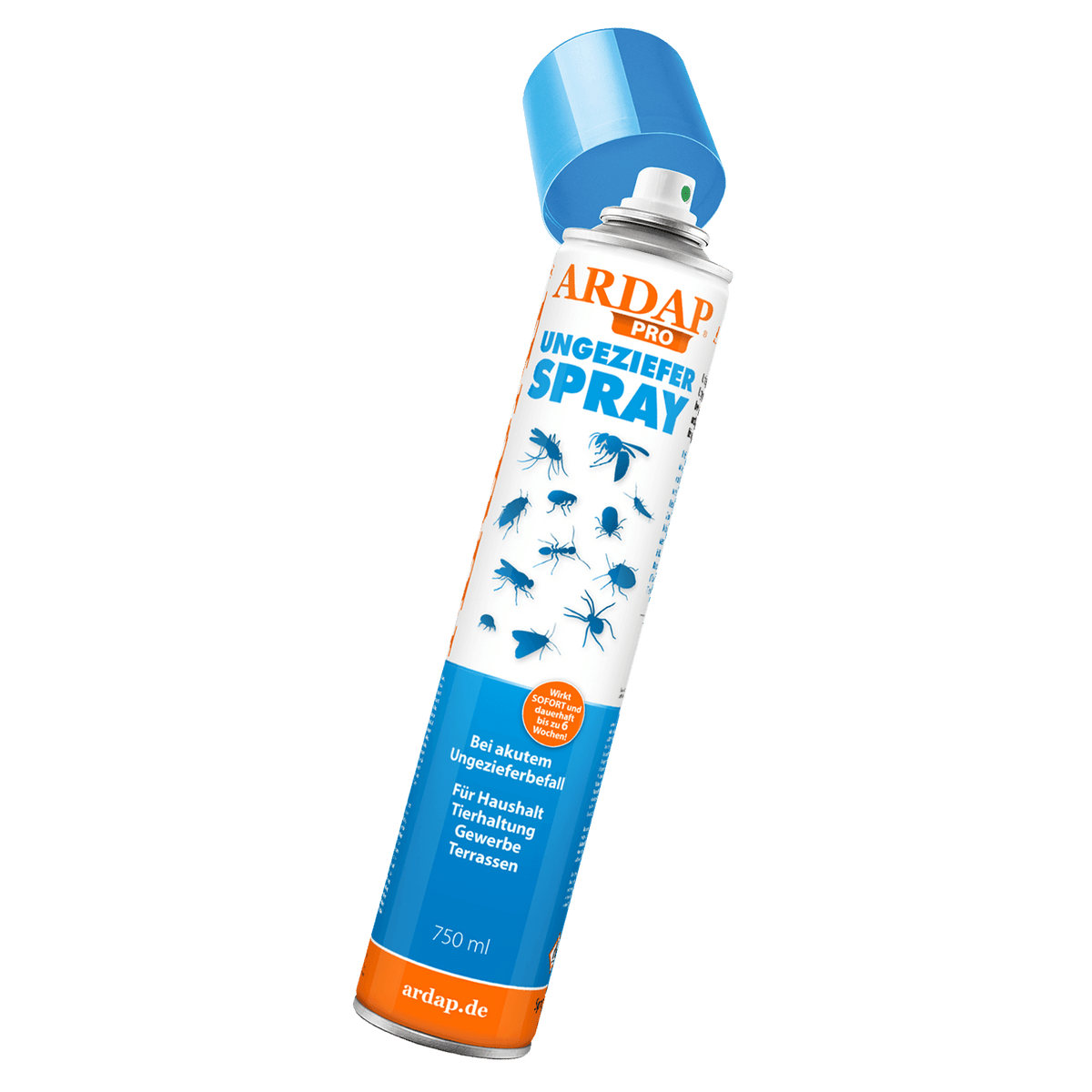
A proven remedy for specifically controlling mosquitoes of all kinds is the ARDAP Pro pest control spray. It kills pests such as the Asian tiger mosquito on contact on sprayed surfaces and enables comprehensive treatment of typical places of stay. It is particularly effective when applied to areas where mosquitoes gather or rest unnoticed – such as sheltered, shaded spots around the house.
To prevent mosquitoes from entering living spaces, it is helpful to treat window frames, door frames, and transition areas between indoor and outdoor spaces with the ARDAP Pro pest control spray. These areas often serve as landing and entry areas for mosquitoes. Upon contact of the tiger mosquito with the sprayed surface, it is immediately controlled. The spray works long-term for a duration of up to 6 weeks. Places of stay in the garden or on the terrace – for example under patio furniture, on walls, in covered areas, or in dark corners – can also be treated. Since the Asian tiger mosquito prefers to stay in quiet, shaded places, these spots are particularly relevant.
Step-by-step instructions: Applying ARDAP Pro pest control spray against the Asian tiger mosquito
-
Step 1: Preparation
Read the instructions on the packaging carefully before use. Shake the can well. Cover aquariums and terrariums and keep cats away during the spraying process. Sensitive surfaces should be tested beforehand at an inconspicuous spot.
-
Step 2: Select suitable spraying areas
Specifically treat the tiger mosquito's preferred places of stay. These include window frames, door frames, roller shutter boxes, transitions between indoor and outdoor areas, as well as shaded, sheltered spots on the terrace or balcony. These areas often serve as resting or entry points for mosquitoes.
-
Step 3: Applying the spray
Apply the spray outdoors or in well-ventilated rooms. Spray from a distance of about 30 cm until the surface is slightly damp. Avoid visible wetness or dripping coatings.
-
Step 4: After application
Ensure adequate ventilation in indoor spaces until the odor is no longer noticeable. The treated rooms can be entered during ventilation. The effect of the ARDAP Pro pest control spray against the Asian tiger mosquito lasts up to 6 weeks upon contact of the insect with the sprayed surface.
-
Step 5: Handling residues
The fine spray film usually dries without leaving stains. If residues are to be removed, they can be removed with a commercially available, water-based all-purpose cleaner.
Conclusion
The Asian tiger mosquito has now established itself as an invasive species, especially in urban areas in Germany, and poses a challenge due to its aggressive properties and the possible transmission of pathogens. Early detection and targeted control in your immediate surroundings contribute significantly to reducing risks. The control of breeding sites, the elimination of standing water accumulations, and the use of proven, highly effective products such as the ARDAP Pro pest control spray enable effective control of the mosquito population.
Frequently Asked Questions
What happens if you are bitten by an Asian tiger mosquito?
If you are bitten by an Asian tiger mosquito, the skin often reacts with intense redness, severe itching, and local swelling. These symptoms are caused by substances in the mosquito's saliva that enter the skin during the bite. In certain regions, the Asian tiger mosquito can also transmit pathogens, which is why bites should be avoided as much as possible. To reduce the risk of bites, it is advisable to take targeted action against mosquitoes in their surroundings. The ARDAP Pro pest control spray is intended for use in the surroundings, for example on typical landing and entry points of the mosquito such as window frames, door areas, or sheltered outdoor surfaces. By properly treating these areas with the ARDAP Pro pest control spray, the mosquito burden and the risk of bites can be effectively reduced.
How do I recognize the Asian tiger mosquito?
The Asian tiger mosquito can be easily recognized by its black-and-white markings and light dorsal stripe. The striped legs are also a clear distinguishing feature from domestic species such as the common house mosquito.
What to do in case of a tiger mosquito bite?
In case of a tiger mosquito bite, it helps to cool the affected area and not scratch. For stronger reactions, a skin-soothing treatment of the irritated area may be advisable. If the bite site becomes inflamed or other serious symptoms such as fever occur, a doctor should be consulted.
Why is the Asian tiger mosquito spreading in Germany?
The increasing spread of the tiger mosquito in Germany is related to climate changes and its high adaptability. Even small water accumulations are sufficient as breeding sites for it, which facilitates its establishment in cities.
How can I prevent tiger mosquito breeding sites in the garden?
Breeding sites can be avoided by removing or regularly emptying all standing water accumulations. This includes saucers, rain barrels, watering cans, playground equipment, or clogged gutters. The breeding sites can also be sprayed with the ARDAP Pro pest control spray to control the tiger mosquito immediately and on contact for a period of up to 6 weeks.
Are pets endangered by the Asian tiger mosquito?
Dogs can be endangered by a bite from the Asian tiger mosquito, as it is a carrier of the heartworm (Dirofilaria immitis). Therefore, it is important to eliminate possible breeding sites in the animal's environment and to protect the surroundings with the ARDAP Pro pest control spray.