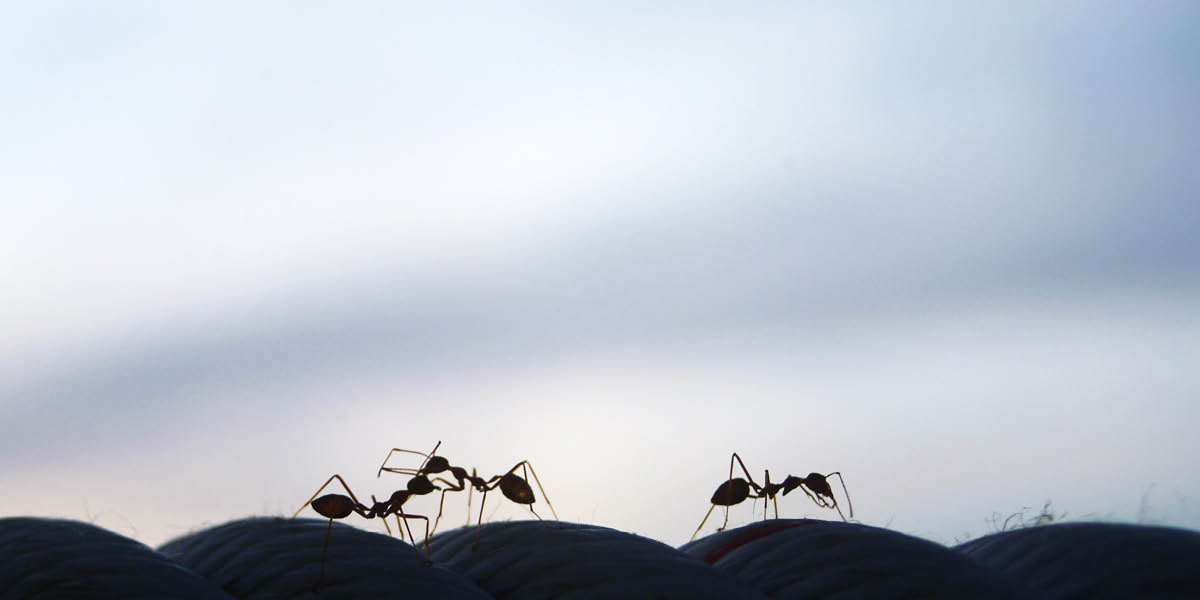
Together with our expert Prof. Dr. med. vet. Norbert Mencke, a specialist in veterinary parasitology, we provide you with valuable information about Pharaoh ants.
Recognizing Pharaoh ants
What does the Pharaoh ant (Monomorium pharaonis) look like, and how can it be distinguished from other ant species? We introduce it with all its characteristics and features.

Appearance and special features
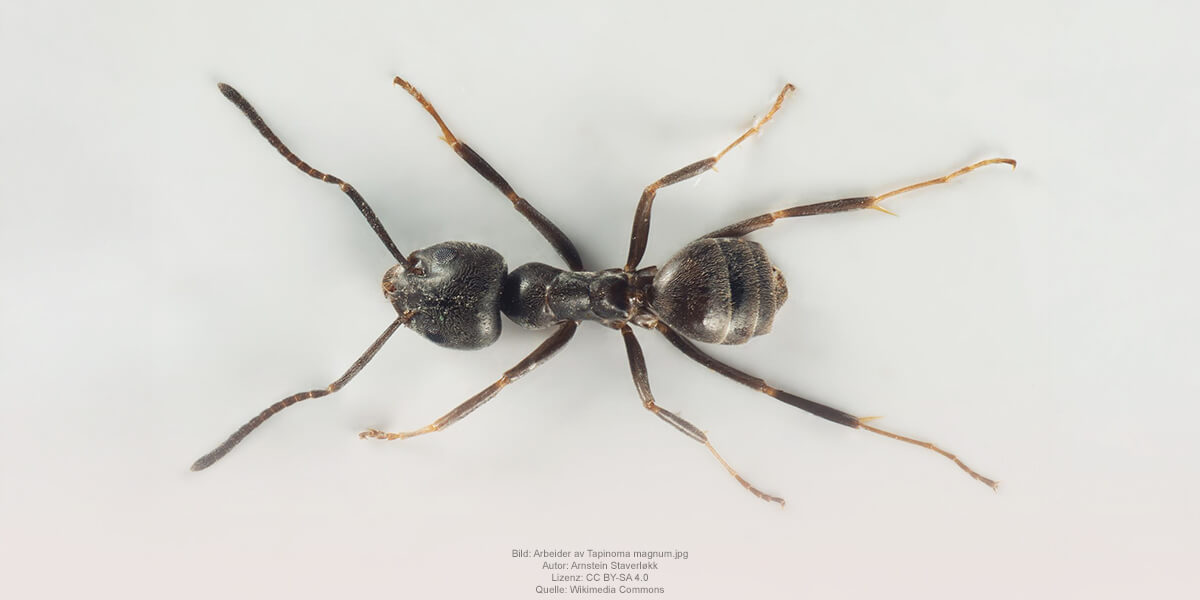
The Pharaoh ant is immediately noticeable for its small size and amber color. Workers of this species measure only two millimeters. This makes these ants relatively easy to overlook, which can naturally delay the implementation of control measures. So it is worth taking a closer look. The queens are also not particularly large, measuring four to five millimeters.
The Pharaoh ant stands out visually from other ant species in Germany. This is mainly due to its light color and almost transparent appearance. Only the tip of the abdomen is dark, while the rest of the body shows the typical amber-yellow color. Striking features of Pharaoh ants include the strong constriction between the middle body section and the abdomen, hence the name knot ants (Myrmicinen). The two humps on the connecting piece between the thorax and abdomen and the antennae with a two-segmented club are also striking.
In this species, the males are slightly larger than the females and show a black color. The queen is also slightly darker than the workers. Nevertheless, the queen's color can also be described as brown to reddish-brown.
The antennae of Pharaoh ants are interesting. They are divided into a total of twelve segments, and the club at the end of the antenna consists of three additional segments. Anyone who looks closely at the Pharaoh ant can also see that the eyes are relatively small in relation to the rest of the body. This is one of the features that is particularly useful for distinguishing it from other ant species.
Origin
The Pharaoh ant presumably originates from Asia or Africa. It was introduced to Europe in the 19th century. Its original range was in the tropics and subtropics. Therefore, it is hardly surprising that it is still a heat-loving ant species. In Germany, it is therefore found mainly indoors. And this is naturally a problem, because these uninvited guests can also cause damage.
How exactly did this ant species get to Europe? This is probably connected to the increasing global trade in the 19th century. Shipping goods by sea enabled this species to reach us. The ants found ideal living conditions mainly in heated indoor spaces. It was very easy for the small insects to travel on ships hidden in cargo. As pests, they appeared in urban areas from the very beginning.
It is therefore obvious that Pharaoh ants feel comfortable in the house and like to spread here. However, from a health and hygiene perspective, this is a problem. Damage to materials and supplies is also absolutely possible with this species. You should therefore know measures that offer the greatest benefit for successful control.

Key facts at a glance
The Pharaoh ant is interested in all foods containing animal proteins. But it is not limited to them. It also eats fruit and sweet foods. It finds optimal growing conditions where there is a temperature between 22 and 30 degrees Celsius. This is usually above the normal outdoor temperature, which is why this ant species likes to come into our homes.
The queens lay their eggs in late summer or autumn. From these develop fertile females and male drones. The queens have wings, but they still do not leave the nest. It takes about three to four weeks for the queens to shed their wings after mating and begin laying eggs. The males die at this point. Workers, on the other hand, reach a lifespan of approximately three months. Queens can live up to one year.
It is not uncommon for some workers to become independent and establish satellite nests. This happens when the first nest has reached a certain size. There is therefore the problem with this species that several nests in the building appear in quick succession. You should not let this happen and invest in control measures in good time. Because once the problem spreads, you will have difficulty getting the situation back under control, as with all other pests.


Not just a nuisance, but highly damaging
Of course, it is always a nuisance when small insects crawl around everywhere in the house. With Pharaoh ants, the aggravating factor is that they can cause serious damage. We will now address this.

Health risks to humans
Pharaoh ants actually pose health risks to humans that should be taken seriously. These ants appear in houses and homes as pests, because the Pharaoh ant contaminates food and transmits pathogens. The presence of these insects in hospitals is particularly problematic. This can lead to the transmission of pathogens. In fact, these ants play a role in the development of hospital-acquired infections.
Because Pharaoh ants are very small, they can spread effortlessly and even get onto our bodies without us noticing. This is problematic everywhere, not just in hospitals or other medical facilities. It is therefore important to take preventive measures so that hygiene and health risks do not arise in the first place. You should definitely realize that we are talking about carriers of pathogens such as salmonella, streptococci, and staphylococci (classified as human pathogens under Section 13 of the German Federal Epidemic Act). Itching is the least of the problems. So it is not a good idea to tolerate Pharaoh ants in your private home.

Damage to materials and supplies!
In addition to health damage, Pharaoh ants can also cause considerable damage to materials and supplies. Food processing businesses are affected, for example. Basically, this ant species is an omnivore - it penetrates the kitchen as well as storage cabinets and warehouses. Here it can contaminate food and therefore poses a real danger.
The ants are often found in meat, baked goods, honey, or sugar. This is understandable because they utilize protein-rich, sweet, and also fatty foods. Therefore, supplies are particularly affected if your home should become infested with Pharaoh ants. So it is also not a good idea to leave food and food scraps lying around. You should at least cover them thoroughly or pack them in airtight containers.
The situation with materials is slightly different. Basically, Pharaoh ants do not directly attack the building structure. Nevertheless, it is possible that their nesting behavior damages materials. It is not uncommon for this ant species to build nests in walls or under the floor. They even go into electrical devices. Damage can therefore occur anywhere, for example on electrical wiring or insulation. You should definitely not let this happen, because dangers such as short circuits can never be completely ruled out.


Pharaoh ants in buildings
You suspect Pharaoh ants in your building and are wondering what to do now? We provide an overview of the problem and explain why you should act quickly and consult a professional.
Particular difficulties
Pharaoh ants possess remarkable abilities and exhibit remarkable behaviors. This includes the fact that they reproduce quickly and have a tendency to form new nests. This presents you with particular challenges in the defense and control of these insects. It is essential that you act quickly before the problem spreads. Pharaoh ants can infest the entire house and then become difficult to drive out.
Basically, you should definitely avoid home remedies when controlling Pharaoh ants. Baking powder, vinegar, or essential oils are ineffective and are by no means suitable for tackling the problem at its root. Pharaoh ants are stubborn and cannot be easily driven out. If in doubt, it is better to consult a professional right away. Control must be carried out promptly to ensure success. Otherwise, the problem spreads quickly and the health of the residents is also endangered.

Control ants with the right products from specialist retailers/h3>
With the ARDAP Pro Ant Bait Box, an effective means of controlling all types of ants, including Pharaoh ants, is at your disposal. The box contains a novel, odorless gel that is particularly attractive to all ant species. They crawl into the bait box and take up the gel there. They then carry the poison contained therein back to their nest and feed it to the queens, among others. In this way, Pharaoh ant nests can be controlled after just a few days.