Our expert Prof. Dr. med. vet. Norbert Mencke tells you all about the common paper wasp and explains what you need to know.
- The common paper wasp - a wasp with long legs
- The common paper wasp nest
- Is the common paper wasp dangerous?
- Conclusion

The common paper wasp - a wasp with long legs
The slender body and long, dangling legs of the common paper wasp are immediately noticeable when it is in flight. We take a closer look at this peaceful visitor in the garden and explain the special characteristics of this insect.
Appearance and special features
Paper wasps (Polistinae), and especially the common paper wasp (Polistes dominula), which is often found in Germany, resemble the common wasp (Vespula vulgaris) and German wasp (Vespula germanica) at first glance, but are generally more delicately built.
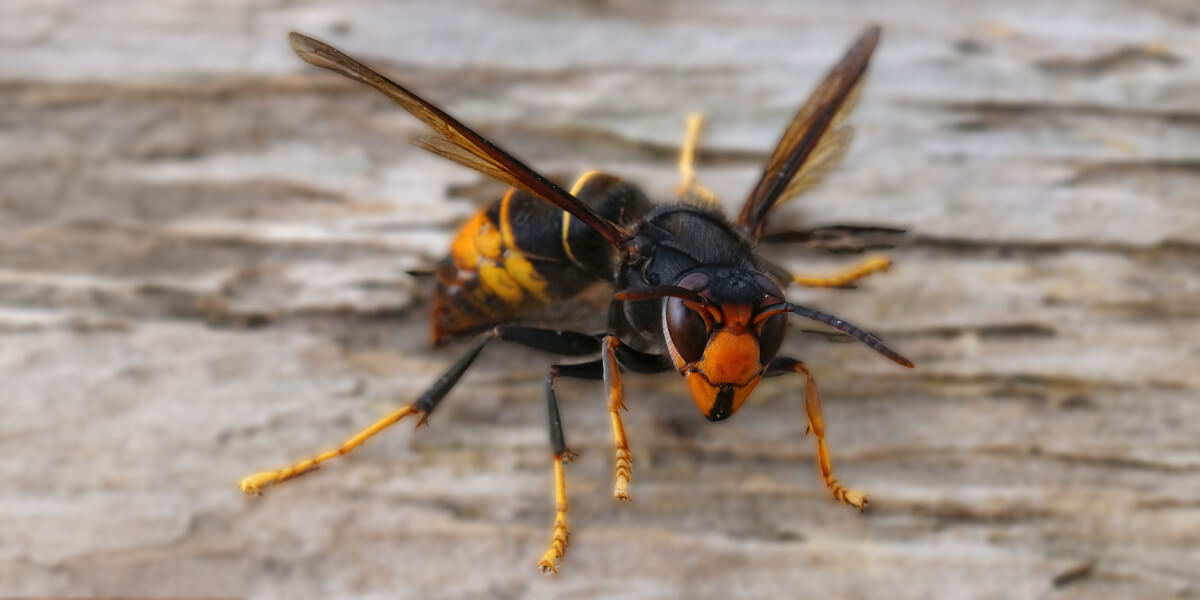
Queens measure up to 18 millimeters, while workers and drones measure between 11 and 15 millimeters. Most striking are the very long hind legs and the two characteristic yellow spots on the second abdominal segment (called the tergum). While Vespula species hold their legs close together in flight, paper wasps let them hang down. It is also interesting that the common paper wasp lacks a special marking on its face. It is simply yellow. Despite similarities such as the yellow-and-black stripes, paper wasps can therefore be quite easily distinguished from other wasp species at second glance.
Occurrence and distribution
In Germany, the common paper wasp (Polistes dominula) is particularly widespread. Thanks to its high adaptability, it easily survives in a wide variety of locations. Nevertheless, it prefers open and warm regions, such as dry grasslands, vineyards, or gravel pits. It also feels comfortable on house facades and under roof overhangs. Seven species from the paper wasp family live permanently in Germany, while a total of 14 species occur in Europe.
Originally native to the Mediterranean region, the distribution of this small wasp has been expanding further north in recent years. However, introduced by ships and aircraft, the common paper wasp has also reached North and South America, Australia and New Zealand, Japan, South Africa, and Chile. Its invasive success is due to its wide range of prey and its ability to attach nests directly to human-made structures.
Lifestyle and diet
The common paper wasp builds small, open nests consisting of about 50 to 150 combs. No more than 30 workers live here. The colony is founded either alone (haplometrotic) or in small groups of sisters (pleometrotic) by young queens in spring after overwintering. Paper wasp colonies are annual, and only the mated young queens survive the winter.
For the larvae, protein is on the menu, which they obtain from flies, caterpillars, and small spiders. Adult paper wasps, on the other hand, have a taste for sugary liquids. Nectar, ripe fruit, and plant juices provide them with carbohydrates.
Threats and conservation status
Wasps are generally protected in Germany[1], and this also applies to paper wasps. Since this species is a harmless beneficial insect, control is not only unnecessary but also prohibited by law. The situation is different in the event of a threat to the German or common wasp.
Paper wasps are dedicated pest controllers that remove large quantities of harmful insects from the garden. They also act as pollinators and prove to be peaceful neighbors. Unlike the German and common wasps, paper wasps are not interested in our sweets or sugary drinks and leave us in peace. They are shy insects that only sting if you reach directly into the nest.

The common paper wasp nest
What does the common paper wasp nest look like, where is it built, and what are its special features? A closer look at the details is worth it.
What does a paper wasp nest look like?
Common paper wasp nests consist of freely hanging combs. These paper-like nests, measuring up to 15 centimeters, have a grayish color and hang from a thin stalk (petiolus). Roof overhangs or wall ledges are among the preferred locations. There is no protective outer shell. This means it has an open construction, where the eggs, larvae, and pupae are clearly visible.
In contrast, the nests of the German and common wasps are surrounded by a multi-layered protective shell. This is why the structures of these two species, which are usually housed underground or in dark cavities, are also significantly larger than those of paper wasps.
What do paper wasps use to build their nests?
Paper wasps simply make the paper required for their nest building themselves. To do this, they chew up wood and plant fibers to obtain the necessary raw material. Fences, posts, corrugated walls, or dry plant stems serve as sources, for example. They then use their saliva as a kind of biological glue. As a result, the wasps build lightweight, highly stable nests.
Unlike the German and common wasps, paper wasps do not enclose the comb with a multi-layered paper sphere. This open single-comb structure has the advantage that the insects require less material and benefit from faster heat dissipation.
Where do paper wasps build their nests?
Factors such as warmth, dryness, and good ventilation are crucial for choosing a location. Paper wasps prefer the sun and therefore choose locations where the required brood temperature can be quickly achieved. At the same time, the nest should be protected from wind and rain. Therefore, solid overhangs, roof eaves, shutters, and wall niches are attractive to these small animals.
In the garden, paper wasps choose vertical plant stems or thin branches to attach their nests to. It is also interesting that these insects like to return to a location they have once chosen in subsequent years. It is therefore typical to find several combs from previous years next to each other after a new nest has been built.
How long do paper wasps stay in the nest?
Paper wasp nest founding takes place from late March to April. The rearing of workers then takes place from May to early June. The nest reaches its maximum size during the growth phase from June to July. During this phase, new workers hatch every day. Males (drones) and young queens are raised by the paper wasps from July to early September. This is the reproductive phase.
Mating flights can take place as early as August in warm weather. The colony collapse then takes place in September or October before the onset of winter. This means that paper wasps stay in the nest for approximately five to six months. Only the mated young queens survive the winter.

Is the common paper wasp dangerous?
With wasps, the question always arises as to what specific dangers they pose to humans. We have taken a closer look at this for you regarding the common paper wasp.
Common paper wasp sting
In principle, wasps have a defensive stinger and can sting if threatened. And this can cause severe pain. However, the probability of a sting occurring at all is quite low with the common paper wasp. Because this species only defends itself when a corresponding threat to the nest arises.
And even if the unlikely event of a sting were to occur, these do not cause allergic reactions, as the stinger can rarely penetrate human skin.
Should the common paper wasp be driven away?
The common paper wasp is a particularly peaceful species that must neither be driven away nor controlled. Unlike the German and common wasps – for which control is tolerated in justified exceptional cases – there is no reason to remove or relocate paper wasps.
These beneficial insects help reduce pests and play an important role in the ecosystem. Instead of displacing them, their presence should be tolerated and their ecological benefits enjoyed.
To avoid conflict, it is enough to keep a respectful distance and not disturb their habitat unnecessarily. Catching, controlling, or relocating is strictly prohibited for this protected species.
Conclusion
The common paper wasp is a remarkable insect with many interesting characteristics. These rather small wasps stand out with their slender bodies and hover around with dangling legs. Their paper-like nests are small and can be found in various locations. They actually prefer warm places, but today they also appear quite naturally in Northern Europe. These adaptable insects are very peaceful and are not attracted by our sugary foods. It is therefore understandable that you should protect paper wasps and welcome them into your home. It is important to keep in mind the differences from the German and common wasps, which, for example, appear more robust and build significantly larger nests. If you also pay attention to the lack of marking on the face of paper wasps, a mix-up should be practically ruled out.