Our expert Prof. Dr. med. vet. Norbert Mencke shows how to deal properly with a wasp infestation and provides detailed advice.
- The Saxon wasp - a long-horned wasp with very distinctive behaviors
- Beware of confusion: reliably identifying the Saxon wasp
- The nest of the Saxon wasp
- Conclusion
The Saxon wasp - a long-horned wasp with very distinctive behaviors
Not all wasps are aggressive and harass humans. The Saxon wasp (Dolichovespula saxonica) belongs to the peaceful wasp species and fortunately poses no threat to us. It shows no particular interest in fruit or baked goods, which is why nests in the vicinity are usually not a problem. However, this species can easily be confused with the quickly aggressive and potentially threatening common and German wasps. It is therefore useful to be able to recognize the typical features in order to rule out a risk of confusion as far as possible. Because you should not and must not control the Saxon wasp.

Appearance and distinctive features: A small wasp
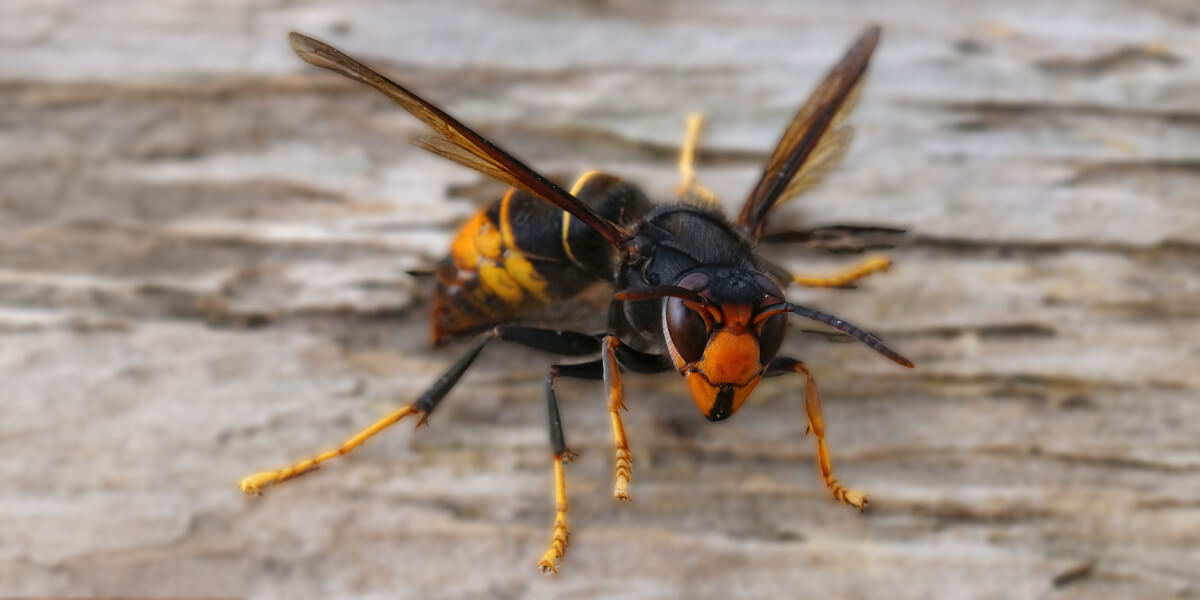
The Saxon wasp is a slender, black-and-yellow long-horned wasp with the following features:
- Size: queen 15–18 mm, workers 11–14 mm
- Distinctive mark: three-pronged marking ("crown") on the clypeus
- Body structure: more delicate than the German and common wasp, longer head
- Risk of confusion: resembles other wasps, but the facial marking is a reliable distinguishing feature.
Compared to short-horned wasps - such as the German or common wasp - the Saxon wasp has an overall more delicate build. The workers grow to only 11 to 14 millimeters, while the queen measures 15 to 18 millimeters. The queen of the Saxon wasp is also characterized by its particularly bold coloration and massive thorax and abdomen.
This species is easily recognizable by its clypeus with a three-pronged marking (crown). The head of the workers is slimmer and narrower than that of the queens. In the males (drones), on the other hand, the antennae are longer and bent.

Occurrence and distribution
The Saxon wasp is established throughout Europe north of the Alps. As far as distribution is concerned, the name of this insect species is therefore misleading. Its distribution area extends even across Asia to Korea and Japan. In Germany, this wasp is practically present everywhere. It is even one of the most common long-horned wasps.
The animals prefer open habitats, but they also enter settlements. In terms of habitat selection, the Saxon wasp thus proves to be flexible. The animals can be found, for example, in open cultural landscapes as well as in field and hedgerow vegetation. They also frequent lightly wooded slopes. In spring, the young queens usually sit alone on dead wood or flowers. From there, they begin searching for a suitable place to build a nest.
They then like to build their freely hanging nests on roof beams or garden sheds. Saxon wasps can therefore also regularly be observed in cities.
Lifestyle and diet
Lifestyle of the Saxon wasp:
- Builds gray, freely hanging paper nests (often on buildings such as barns, garden sheds, summerhouses, or tool sheds)
- Forms small colonies of max. 300 animals
- Peaceful and not interested in human food
Diet of the Saxon wasp:
- Adult wasps: flower nectar and honeydew (no interest in sweets!)
- Larvae: fed with protein-rich insect paste (e.g., chewed flies and other insects)
The lifestyle of the Saxon wasp includes the construction of spherical, gray-colored nests. Using their mouthparts, the mandibles, they rasp decayed wood into a wood paste as raw material. Nest building preferably takes place in lightly wooded areas, in open landscapes, and very often freely hanging near buildings. It is therefore not unusual to have Saxon wasps as animal neighbors: in the attic and also in outbuildings such as the tool shed, garden shed, or barn. A colony comprises a maximum of 300 animals.
Flower nectar and honeydew are on the menu for the adult animals (imago), because they need the carbohydrates from them to survive. The larvae, on the other hand, are fed with protein-rich insect paste. The workers hunt flies, mosquitoes, and other small insects for this purpose, which they chew into a paste and then feed to their larvae.
Protection status and benefits of the Saxon wasp
According to the Federal Nature Conservation Act[1], it is generally prohibited to catch or kill wasps without a reasonable cause or to destroy their nests. Control is only possible for certain wasp species if a corresponding permit from the authorities is available, or if a reasonable cause, such as a health hazard, exists.
There are wasp species that, according to the Federal Species Protection Ordinance[2], belong to the specially protected species. These include, for example, the hornet wasp, carpenter wasp, or also the European hornet native to Germany. These wasp species must not be controlled under any circumstances.
The Saxon wasp is not included here, but since it is peaceful and is neither a nuisance nor a pest to us humans, this wasp species should also not be controlled. The imago of the Saxon wasp does not go for cake, ice cream, or sweets and poses no threat. Rather, it is a beneficial insect that carries out natural pest control through its hunting behavior and also pollinates numerous wild and cultivated plants.

Beware of confusion: reliably identifying the Saxon wasp
Many wasp species look quite similar, so colors such as black and yellow are always present. Therefore, it can quickly happen that laypeople confuse harmless wasps with potentially dangerous ones. So that this does not happen to you, we have listed important distinguishing features for the wasp species that are particularly common in our latitudes.
In the following table you will find the essential features of the Saxon wasp (Dolichovespula saxonia) compared to the German wasp (Vespula germanica) as well as the common wasp (Vespula vulgaris) at a glance:
| Feature | Saxon wasp | Common wasp | German wasp |
|---|---|---|---|
| Facial marking | Clypeus with three-pronged marking (crown) | Clypeus (Clypeus) with anchor-shaped marking | Clypeus (Clypeus) with 1 to 3 dots |
| Head shape | Long-horned wasp (greater distance between the eye margin and the base of the upper jaw) | Short-horned wasp (significantly shorter distance between the eye margin and the base of the upper jaw) | Short-horned wasp (significantly shorter distance between the eye margin and the base of the upper jaw) |
| Size | Queen: 15–18 mm Worker: 11–14 mm |
Queen: 16–20 mm Worker: 11–14 mm |
Queen: 16–19 mm Worker: 12–14 mm |
| Nest proximity to humans/buildings |
Often outside on buildings (sheds, roof structure); easily visible | Often hidden in the building (roller shutter boxes, ceiling voids) or directly in the garden soil | Cavity nesters, roller shutter or attic boxes; rarely open; usually hidden and less visible |
The nest of the Saxon wasp
Anyone who deals with a wasp species cannot ignore its nest building. The animals invest a lot of time in this, and the gray "paper structure" of the Saxon wasp is usually hard to miss. We will tell you how the nest is built and what its special features are.
Where and how does the Saxon wasp build its nest?
Saxon wasps choose the location for their nest according to certain criteria. For example, sun warmth is important so that the energy expenditure for brood heating is lower. In addition, there should be wind protection. For example, roof ridges and hedges are suitable places. Furthermore, the food supply nearby should be large enough so that the insects save flight time. The typical gray paper balloon is often securely attached to roof overhangs.
In terms of material, the nests consist of fibers that the wasps obtain from various sources. These can come, for example, from firewood, wooden stakes, or cardboard. Among the wood types, this wasp prefers softwoods such as poplar. They glue these fibers together with their saliva. This results in a marbled gray stripe pattern that is typical for the nests of this species.

Does the Saxon wasp defend its nest?
The Saxon wasp is a peaceful animal that generally poses no danger to humans. In everyday life, it never behaves aggressively toward humans. However, exceptions are also possible here, and it should not be forgotten that these wasps can also sting. It becomes critical whenever you approach the nest too closely. All wasps react to this and take a defensive stance. So do not go too close to the nest and avoid vibrations.
It is also advantageous that the Saxon wasp is not interested in our food. This is typical for long-horned wasps and prevents conflicts from the outset. The animals specifically search for flowers and not for cake or cookies. Even if there should be a nest nearby, the wasps therefore hardly visit the terrace or balcony.
Relocating the nest of the Saxon wasp?
Even the most peaceful wasp species can pose a danger if the nest hangs in a particularly unfavorable place, such as directly on a children's climbing frame or playhouse. If allergy sufferers or elderly and other immunocompromised persons are nearby, a wasp sting - regardless of the species - can always pose a risk. If an exceptional permit or reasonable cause exists, a relocation of the nest of the Saxon wasp to another place can take place. But this is a measure that you should not carry out on your own. It is then better to contact an experienced pest control company and seek their advice. The relocation should then take place when as many workers as possible are in the nest. This is the case in the early morning hours or at night. A suitable new location must be chosen, and a follow-up check is required to see whether all the animals find the nest at the new location again. Professional help is therefore essential here.
Conclusion
With the Saxon wasp, a peaceful coexistence is easily possible. This species does not behave aggressively, and it does not go for our sweets or the barbecue. It is rather small colonies that are active as beneficial insects in the garden, and whose nests we can tolerate nearby without exposing ourselves to danger. If problems should nevertheless arise, it is usually sufficient to keep your distance or redirect the flight path of the insects. With the help of a professional, relocation of the nest along with the wasp colony can also take place in exceptional cases.