Therefore, it is particularly important to know the differences between the individual species and to be able to identify the European hornet as clearly as possible.
Our expert Prof. Dr. med. vet. Norbert Mencke shows how to deal properly with a hornet infestation and advises you on the necessary steps.
- The European hornet - a peaceful companion
- No chance of confusion! Distinguish the European hornet and other species at a glance
- Ecological benefits and protection status of the European hornet
- Is the European hornet dangerous?
- Relocate European hornet nests?
- Conclusion
The European hornet - a peaceful companion
The European hornet (Dolichovespula media) is also called the "small hornet" and belongs to the largest colony-forming hornet species in Germany. It is therefore quite likely that you will encounter these insects at some point, which can appear almost black from a distance. Visually, the animals are definitely something special, because the yellow that is otherwise so typical for hornets is less dominant here.
The European hornet acts as a beneficial insect and is under general nature protection, as it makes a valuable contribution to the ecosystem. In addition, they are peaceful insects and fascinating creatures that are extremely interesting to learn more about.
No chance of confusion! Distinguish the European hornet and other species at a glance
| Feature | European hornet | German hornet | Common hornet | European hornet | Asian hornet |
|---|---|---|---|---|---|
| Body structure | slender | compact | compact | conspicuously large | large |
| Coloration | dark red to black, narrow yellow stripes | conspicuously yellow-black striped, head pattern with 1–3 dots | yellow-black striped with anchor-shaped head pattern | red-brown-yellow | black base color, yellow leg ends |
| Worker size | 15–19 mm | 12–16 mm | approx. 15 mm | 25 mm | 17–24 mm |
| Behavior | peaceful | aggressive when (nest) disturbed | aggressive when threatened and nest disturbed | peaceful, only aggressive when threatened | aggressive |
| Nest construction | freely hanging paper nests with entrance tube | in cavities in and on buildings | often in tree cavities or rodent burrows | reddish colored, in tree cavities/buildings | Early phase: roof overhangs, hedges Later: high in trees |
| Control | not permitted | permitted under certain circumstances (reasonable grounds) | permitted under certain circumstances (reasonable grounds) | prohibited, specially protected | permitted and partly required |
Appearance and special features
- Size & color: Queens 18-22 mm, workers 15-19 mm; colored red-yellow to almost black, with little yellow.
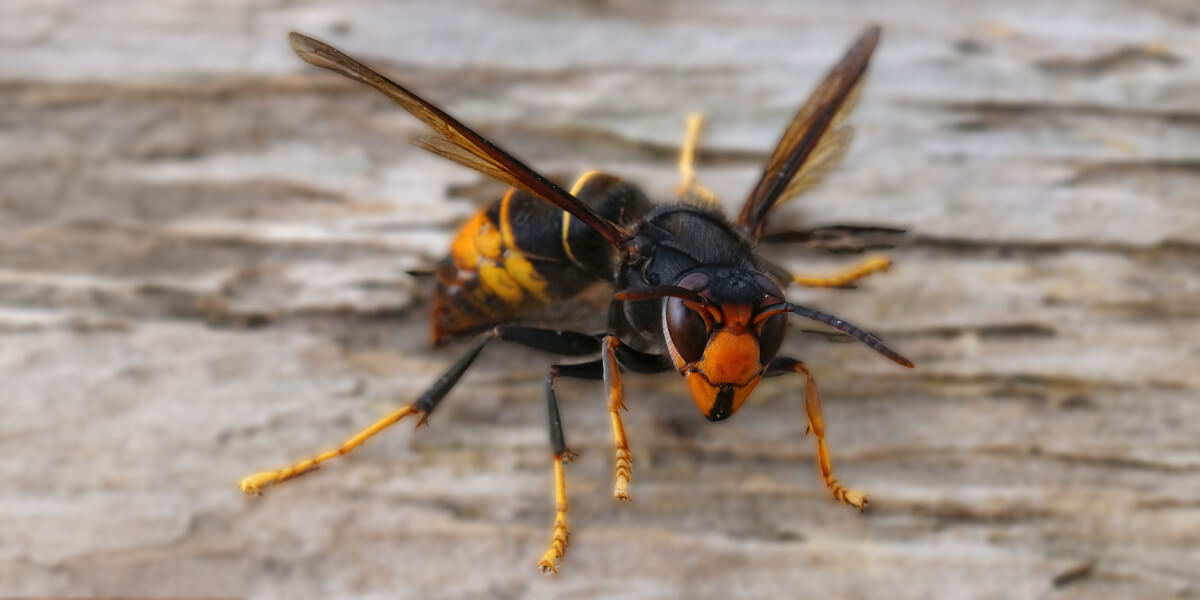
- Distinctive: Often confused with the Asian hornet due to the dark base color, but has a slimmer body structure.
- Name: It is also called the “small hornet”.
- Head pattern: No conspicuous pattern like other hornets, but a strong red-black coloration.
- Queens: Young queens strongly hairy, older queens with worn wings and a slender abdomen.
- Drones: Males have longer antennae and no stinger.
- Workers: are more contrastingly marked than the other animals in the colony.
The European hornet is easily recognizable by its strong dark red coloration and the narrow yellow stripes. Sometimes this dark red is so dark that the animals practically look black - especially from a greater distance. Due to the variable coloration, it can also happen that we confuse the insects with the Asian hornet. So here you have to look closely in everyday life. Basically, it can be said that the European hornet belongs to the large native hornet species. The queens can reach a size between 18 and 22 millimeters. The workers and drones are slightly smaller, measuring between 15 and 19 millimeters in length. The Common hornet (Vespula vulgaris) is, for example, significantly smaller in comparison here.
If you want to recognize a queen of the European hornet, you should look for the dense coat of hair and the intact wings in the young queens. Her abdomen still has abundant fat reserves. Overall, her flight therefore appears heavier. In contrast, the wings of the established queens are already frayed and shorter. In addition, the hair has been rubbed off. The months-long nest work shows its traces here. Furthermore, the established queens have a slimmer abdomen after laying eggs. The workers, in turn, are more contrastingly marked than the other animals in the colony. In the males (drones), you can look for the longer-looking antennae and that the abdomen does not have a stinger.

European hornet, image: Dolichovespula media-pjt1.jpg, license: CC-BY-SA-4.0, source: Wikimedia Commons, location: Forest near Stuttgart, photographer: Pjt56
Origin and distribution
The European hornet belongs to the family of vespids (Vespidae) in the subfamily of the true hornets (Vespinae) and here to the genus of the long-headed hornets (Dolichovespula). The scientific name of this hornet species is Dolichovespula media. It was first scientifically recorded in 1783 by the Swedish naturalist Anders Jahan Retzius. The species is now widely available and lives in the northern hemisphere. Forests with poplar and other softwoods are preferred for nest building. In Central Europe, this species is widely distributed, although it is locally rather rare to find. In Southern Europe, for example, it can only be found in mountainous regions such as the Alps or the Pyrenees.
The typical habitat includes open forests and the forest edge as well as bushes. With softwoods, the hornets are after the weathered bark. From this material, the insects chew the paper pulp for their nests. In the cities, this hornet species is now also widespread. The park and settlement greenery offers corresponding development opportunities here in hedges, tree rows, and orchards.
The special features of nest building include the freely hanging paper nests one to five meters above the ground. Mostly, these are found in bushes or under roof overhangs. The nest has an entrance tube or a kind of entrance tube (vestibule), which protrudes vertically downwards. In research, it is assumed that this serves for thermoregulation or defense.
In contrast, the nests of the German hornet (Vespula germanica) and the Common hornet (Vespula vulgaris) resemble each other in their paper-like structure made of chewed wood, but show differences in location and appearance. The German hornet prefers dark, protected cavities for its nest building, such as roller shutter boxes, attics, earth holes, or wall cracks. The Common hornet, on the other hand, is more frequently found outdoors.
Lifestyle and nutrition
- Nest construction: Builds freely hanging paper nests (often in bushes or on buildings) with a characteristic entrance tube.
- Colony development: Nest founding in April/May, peak in July/August, dissolution from August – only young queens overwinter.
- Nutrition (Imago): Feeds on nectar and honeydew – no interest in human food such as sweets.
- Larvae feeding: Workers hunt insects (e.g. flies, mosquitoes) as a food and protein source for the larvae.
- Beneficial insect: Important pollinator and natural pest destroyer – under nature protection!
In Central Europe, the nest founding of the European hornet takes place from approximately mid-April to early May. The young queen builds the nest typical for this species with an entrance tube and uses poplar or willow fibers for this. This nest is not yet fully developed, but is already suitable to lay the first eggs and feed the larvae in it. In the time from May to June, the workers then hatch, who take over tasks such as hunting, larvae feeding, or further nest building. This is a phase of rapid growth with the formation of many additional combs. The hornet colony then reaches its peak in July or early August. Hundreds of workers are now active. Now the rearing of drones and young queens also plays a role. Already from mid to late August, the colony dissolution takes place. The old queen dies and the entire colony perishes with the exception of the young queens mated by the drones. The latter leave the nest and go in search of a suitable winter quarters. The overwintering then takes place from October to early April. For this, the young queens must have previously fattened up sufficient fat reserves.
With regard to nutrition, nectar and honeydew are on the menu for the adult animals (Imago). The larvae, on the other hand, feed on insects, because they need proteins for rapid growth. The workers chew the prey into a pulp and pass this on to the larvae.

Ecological benefits and protection status of the European hornet
The European hornet is a peaceful species, which mostly avoids the proximity of humans. In addition, it is a beneficial insect, which we must not carelessly control. Just like all other hornets, it is under the general protection of the Federal Nature Conservation Act[1], even if it is not explicitly listed as a species here. The European hornet is almost as large as the European hornet, which is specially protected according to the Federal Species Protection Ordinance[2]. However, in terms of color, it looks confusingly similar to the Asian hornet, both are dark and predominantly black in color. However, controlling the small hornet, as the European hornet is also called, is not permitted, or rather not necessary, because it is not aggressive.
The ecological benefits of the European hornet refer among other things to biological pest control. Since the protein of other insects is necessary for the rearing of the larvae, the workers catch flies and mosquitoes in large numbers, for example. You also feel this positive effect as a private person in your fruit or vegetable garden. Thanks to the diligent work of the hornets, the pest pressure is lower. In addition, this insect species provides an important pollination service. Since the adult animals need carbohydrates, they visit various plants and transport pollen. Therefore, the European hornet should be welcomed in the garden.

Is the European hornet dangerous?
The European hornet is a peaceful companion. This insect generally does not pose a danger to humans. Nevertheless, it is important to bear in mind that hornets can always sting - and this is also the case in exceptional cases with the European hornet.
What is decisive is where the nest is located. If this is the case, for example, on the terrace roof or on the balcony railing, this can certainly pose a danger to humans and pets. Because hornets defend their nests and really do not like it when we or our pets come too close to them. If you irritate the hornets and enter their defense radius, it is therefore quite possible that you will be attacked.
In terms of insects like the European hornet, however, ignorance and fear reactions are particularly problematic. Typical here is especially the confusion with hornets, which can quickly lead to overreactions, although at least the European hornet is also a peaceful species that avoids human proximity.
With the Asian hornet, there is a similarity at first glance due to the dark-looking base color. However, this invasive species is larger and easily distinguishable by its yellow leg ends.
Hectic arm movements are generally not very helpful and should fundamentally be avoided in the vicinity of hornets. The situation looks slightly different for people with allergies. For these, a hornet sting can be potentially life-threatening. Then it may even be necessary to relocate the European hornet nest.

Relocate European hornet nests?
Under certain circumstances, a wasp nest can pose such a significant danger that relocating the colony may be necessary—for example, if young children or people with allergies are at risk. In any case, there must be an acute danger. Relocation requires a valid, verifiable reason and a qualified professional. Without an exemption permit, for example from the local nature conservation authority, you must not take action yourself. The fact that the nest is unsightly or that the wasps are considered a nuisance is not sufficient justification. An assessment by a professional is therefore strongly recommended.
Relocation may also be considered if it is necessary for the execution of construction work. This could be roof renovation or the erection of scaffolding. In most cases, however, the authority will require proof that it is unavoidable. If the relocation is actually permitted, it should take place from May to July, because experience shows that the success rate is particularly high at this time of year. Here too, consultation and execution by a qualified professional are absolutely essential.
Conclusion
The European hornet (Dolichovespula media) is an extremely peaceful and unobtrusive neighbor. While its relatives—the German wasp and the common wasp—are happy to make off with our cake or grilled meat, becoming very annoying and even dangerous, the European hornet shows no interest in human food. Instead, it feeds on nectar, plant juices, and preyed-upon insects such as flies or mosquitoes.
This species of wasp is not only harmless but also very useful. It contributes to natural pest control by hunting aphids and other insects. Peaceful coexistence is therefore easily possible and can even be beneficial.
Make sure that you do not mistake this beneficial insect for the common wasp, the German wasp, or the Asian hornet, so that you do not accidentally exterminate the European hornet.