We have taken a closer look at European hornets for you and will introduce you to them in all their facets. We will also explain what options you have to take appropriate action against these insects in a dangerous situation with reasonable grounds. Our expert Prof. Dr. med. vet. Norbert Mencke shows solutions in the event of a threat from European hornets.
- Which wasp species belong to the European hornets?
- Typical characteristics of European hornets
- Know the legal regulations, act prudently
- In case of acute danger and reasonable grounds: What helps against wasps?
- Conclusion
- Frequently asked questions
Which wasp species belong to the European hornets?
The subfamily of European hornets (Vespinae) from the family of vespids (Vespidae) includes around 74 species worldwide. Of these, 11 species live in Central Europe. We will take a closer look at the most important species, where you are most likely to encounter them in everyday life.

At a glance: The best-known European hornets
- German wasp (Vespula germanica)
- Common or European wasp (Vespula vulgaris)
- Asian hornet (Vespa velutina var. nigrithorax)
- European hornet (Vespa crabro)
- Saxon wasp (Dolichovespula saxonica)
- Middle wasp alias Lesser hornet (Dolichovespula media)
The German Wasp
The German wasp (Vespula germanica) can be identified by the 1-3 black dots on the yellow clypeus. Another characteristic is its pronounced distance between the lower eye margin and the base of the mandibles (mouthparts). This characteristic gives the genus (Vespula), the so-called short-headed wasps, its name. This wasp species quickly becomes aggressive in the event of a disturbance. It is generally a beneficial insect, but due to its aggressiveness it can also become a pest and a health hazard to humans. If the German wasp becomes a real problem in the garden, on the terrace or balcony, appropriate measures can be taken in good time if there are reasonable grounds for hazard prevention, e.g. for allergy sufferers or the endangerment of toddlers and infants.
The Common Wasp
The common or European wasp (Vespula vulgaris) is easily recognizable by its yellow clypeus (Clypeus) with a black anchor-shaped marking. Here, just as with the German wasp, it applies that control under certain circumstances and the presence of reasonable, verifiable grounds is tolerated. Because this species is also characterized by aggressive behavior and can pose a health hazard to certain groups of people.


The Asian Hornet
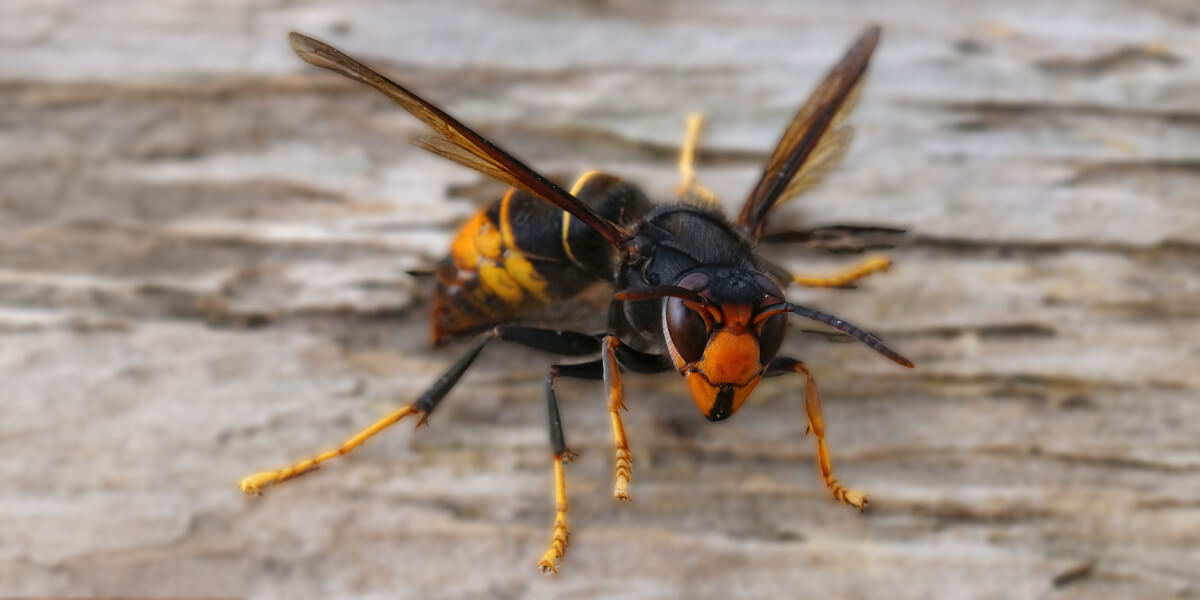
The Asian hornet is easily recognizable by its dark body coloration with yellow leg tips, the orange band on the abdomen and its slightly smaller size (compared to the European hornet). Unlike the native hornet species, it is not subject to protection, but is considered an invasive species that should be actively and professionally controlled.
This hornet species shows particular aggressiveness towards honeybees and can threaten entire bee colonies. Although its sting is not more dangerous to humans than that of a wasp, it defends its nest particularly vigorously. Due to the danger to the native insect world, especially wild and honeybees, its professional control is required.
The European Hornet
The European hornet (Vespa crabro) can be identified by its large, red-brown-yellow coloration and its impressive size (up to 3.5 cm). In contrast to the Asian hornet, it is a native species and is strictly protected, as it is threatened with extinction – control is not permitted. Unlike wasps, the European hornet is usually very shy, peaceful and defends its nest only in case of direct threat, if at all. Its sting is not more dangerous than that of a wasp or bee. As a beneficial insect, it maintains the ecological balance through its insect hunting and plays a very important role in our ecosystem. This species must absolutely be protected.
Other European Hornets
The Saxon wasp is (Dolichovespula saxonica) can be identified by its black-and-yellow marking with characteristic "anchor spots" on the abdomen. In contrast to the annoying German or common wasp, this species shows an extremely peaceful behavior. It prefers to build its gray, freely hanging nests in bushes or under roof overhangs.Since this wasp species shows no interest in human food and rarely becomes aggressive, control is not permitted. As a pollinator and pest controller, it also fulfills important ecological functions.
The Middle wasp (Dolichovespula media) can be identified by its coloration with only very narrow yellow bands on a large black area and its slightly larger stature. Like the Saxon wasp, it usually builds its gray nests in bushes or trees and shows no aggressive behavior towards humans.
This wasp species is particularly shy and stings extremely rarely. Since it also develops no preference for sweets, there are hardly any conflicts. Although its protection status is not as strict as that of the European hornet, control is ecologically unjustifiable and therefore prohibited.

Typical characteristics of European hornets
As already shown above, the European hornets (Vespinae) include different species that can be distinguished from each other more or less clearly. But there are also typical characteristics and behaviors that all European hornets have in common. We will take a closer look at these in the following.
The most important at a glance:
- Body structure: Slender "wasp waist" (strong thorax, narrow first abdominal segment)
- Size:
- Workers: 10–15 mm
- Queens: up to 20 mm
- Asian hornet: worker 17-24mm, queen up to 30mm
- European hornet: worker 18-25mm, queen up to 35 mm
- Coloration: Black-and-yellow warning marking (partially orange/red-brown)
- Wings: Paper-thin, coupled wing pairs (folded lengthwise at rest)
- Stinger: Only in females (smooth, without barbs → reusable)
- Social structure:
- Eusocial (formation of colonies with queen, workers, drones)
- One-year colonies (only young queens overwinter)
- Communication through pheromones
- Aggressiveness:
- German wasp & common wasp: quickly aggressive near the nest
- Asian hornet highly aggressive
- European hornet and many other wasp species: peaceful (protected!)
- Nest building:
- Young queen founds nest in spring (embryonal nest → later larger nest)
- Material: wood fibers (paper nest)
- Asian hornet with three nests (embryonal, primary and secondary nest)
- Development:
- Metamorphosis (holometabolous development: egg → larva → pupa → imago)
- Duration: 28–48 days

Appearance of European hornets
The body structure of European hornets (Vespinae) is characterized by the slender wasp waist. While the thorax is strongly pronounced, the first abdominal segment tapers behind it. The abdomen then widens significantly again. The queens reach a length of 20 millimeters and the workers about 10 to 15 millimeters. The largest native species is the European hornet with about 35 millimeters, which also zoologically belongs to the European hornets.
European hornets can also be identified by their paper-thin wing pairs. The forewings and hindwings are coupled together in flight, which makes them look like a continuous wing. When the animals are at rest, they fold the wings lengthwise along their bodies.
European hornets are also recognizable by their black-and-yellow warning coloration. Predators immediately know that these insects are armed and have venom glands with which they know how to defend themselves. Sometimes - depending on the wasp species being viewed - orange or red-brown tones are also present.
Only the females of the European hornets possess a stinger. This is actually a modified ovipositor. There are no barbs, the stinger is almost completely smooth. Therefore, it can be pulled out of the victim again after stinging. This is one of the differences to the honeybee, which cannot use its stinger multiple times, because its stinger has barbs.

Social colony formation
European hornets belong to the so-called eusocial insects. This is understood as the highest form of social organization in animals: with division of labor, cooperative brood care and overlapping generations (parents and offspring live and work simultaneously in the same nest). The new colony is founded in spring by the young queen mated in the previous year. She builds a first embryonal nest, from which the nest with numerous workers later develops. The rearing of the sex animals (drones and young queens) takes place in late summer. Only the young queens survive the winter. The old queen dies together with all the other animals of the wasp colony. It is therefore a one-year colony. To survive the winter, a mated young queen must enter a cold dormancy. Communication within the nest and the development of an insect into a specific role in the social group (queens, workers or drones) takes place essentially via pheromones. It is interesting that in addition to the colony-forming animals, there are also solitary (alone-living) wasp species.
Developmental stages
European hornets undergo a complete metamorphosis, which is called holometabolous development. This includes egg, larva, pupa and imago (adult animal). After about 5 to 8 days, the whitish and eyeless larvae hatch from the eggs. The transition to the pupal stage takes about 15 days and includes five molts. After 8 to 18 days, the adult wasp forms from the pupa, which has compound eyes, wings and a stinger. For the Central European species, it can be assumed that the entire development process takes about 28 to 48 days, depending on the temperature.

Know the legal regulations, act prudently
Some true wasps can be very annoying and appear threatening. However, they are generally peaceful creatures. That is why these animals are protected and must not be killed or have their nests simply removed. The only exceptions are the common wasp and the German wasp, which can sometimes become very aggressive and whose control is not fundamentally prohibited. However, there must be reasonable and verifiable reasons for this, justifying a particular danger situation for vulnerable people such as allergy sufferers, young children, or weakened people. We explain the legal background. This also applies in particular to the Asian hornet, which is very aggressive and, unlike the German and common wasp, should be professionally controlled.
At a glance:
- Federal Nature Conservation Act (BNatSchG):
- Ban on catching, killing, and destroying nests without reason
- The Saxon wasp and the common European wasp do not pose a danger to humans and therefore must not be controlled.
- The control of the German wasp & the common wasp is tolerated in cases of danger and when reasonable reasons exist in individual cases.
- The Asian hornet, as an invasive species, poses a threat to our native insects and should therefore be professionally controlled.
- Reasonable reasons for control
- Proven insect venom allergy
- Danger to children, seniors, or vulnerable people
- Federal Species Protection Ordinance (BArtSchV):
- Strictly protected species (e.g., European hornet, European hornet wasp, European hornet wasp, and others) → no control allowed!

Possible reasonable reasons for the deterrence and control of the common wasp and the German wasp
If you want to control the German wasp and the common wasp, there must be a compelling reason for this, which must also be verifiable. Because under the Federal Nature Conservation Act[1], it is not permitted to catch, kill, or destroy the nests of wasps at your own discretion without a permit, or if there is no health hazard. In contrast, the Asian hornet is considered an invasive species that threatens our native ecosystem and should therefore be professionally controlled in consultation with an expert.
A typical example of a valid use case is if you can prove that you have an insect venom allergy or that one of your household members has an allergy. It is also possible that infants and young children or older people with a high need for protection cannot avoid the nest, e.g. if it is located in the immediate vicinity of a children's playground or a sandbox, and should therefore be removed due to the health hazard. With regard to the legal situation, please also consider the Federal Species Protection Ordinance[2], which provides further details on the special protection of certain species. It is also recommended to seek the advice of an expert (pest control professional) before any possible control.
Precautions when dealing with wasps
We can do a lot ourselves to minimize the risks when dealing with wasps. It is therefore generally important not to approach the nest or the hunting grounds of the wasps, as they exhibit aggressive behavior in case of threat. Avoid hectic movements and never swat at the animals. If you trigger the insects' defensive reflex, it is understandable that they will behave aggressively towards you.
If control is unavoidable, the respective product instructions should be read carefully and only approved wasp products from specialist retailers should be used.
Protect yourself and wear a thicker shirt, long pants, and sturdy shoes. In addition, using eye protection is highly recommended.
In case of acute danger and reasonable reasons: What helps against wasps?
If there is an acute danger and a reasonable reason for deterrence or control, the right wasp product is essential. Because wasps are not that easy to drive away. We will show you proven solutions. It is always important to seek the advice of an expert or a pest control professional before use.

Deterring wasps
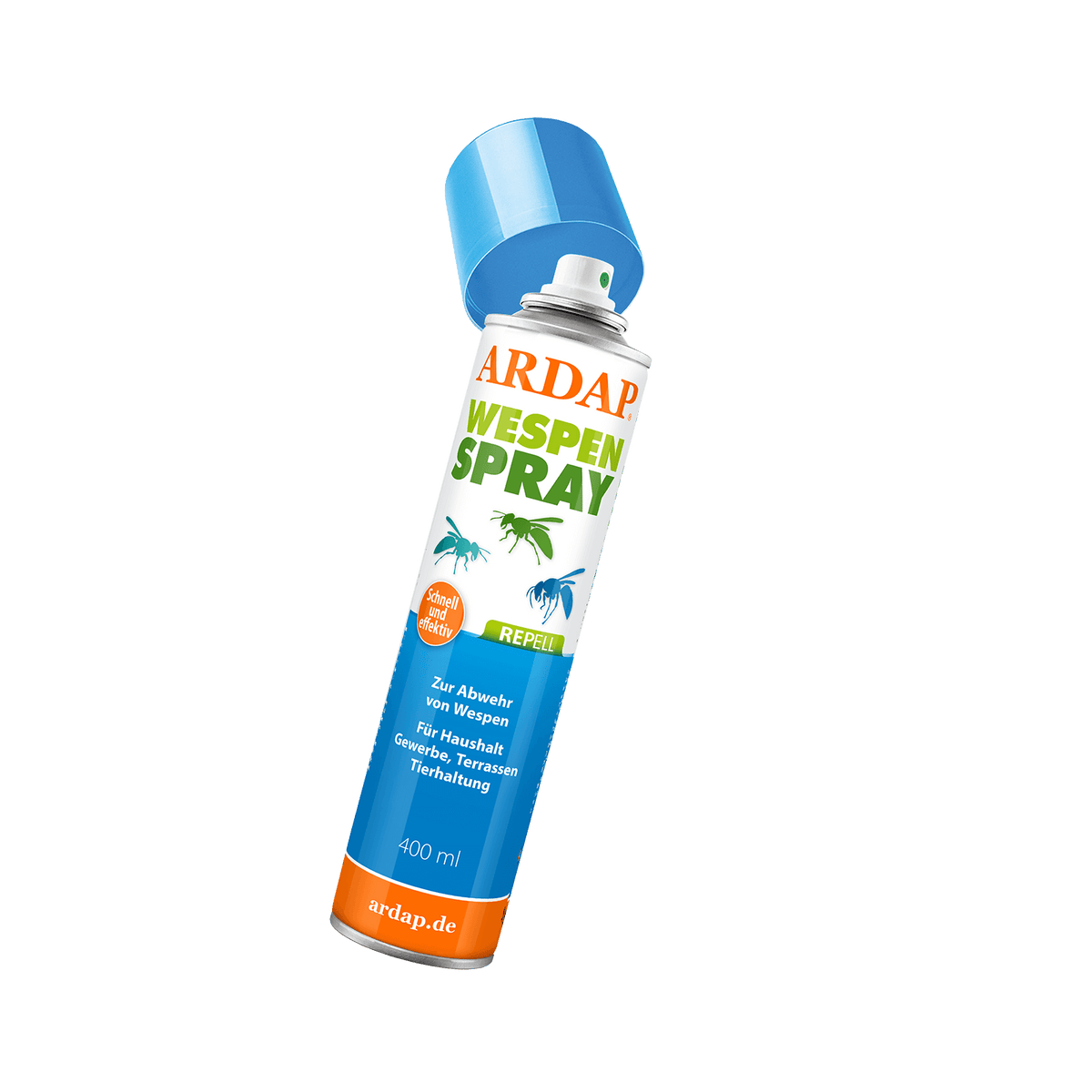
The ARDAP Repell wasp spray is a fast-acting product for the deterrence and driving away of wasps. This product is suitable for use in the home or outdoors, such as on a terrace or balcony. Shake the can thoroughly before use and then spray a two-meter stretch for one second. Wasps will then avoid the treated areas.
Professional trap from specialist retailers
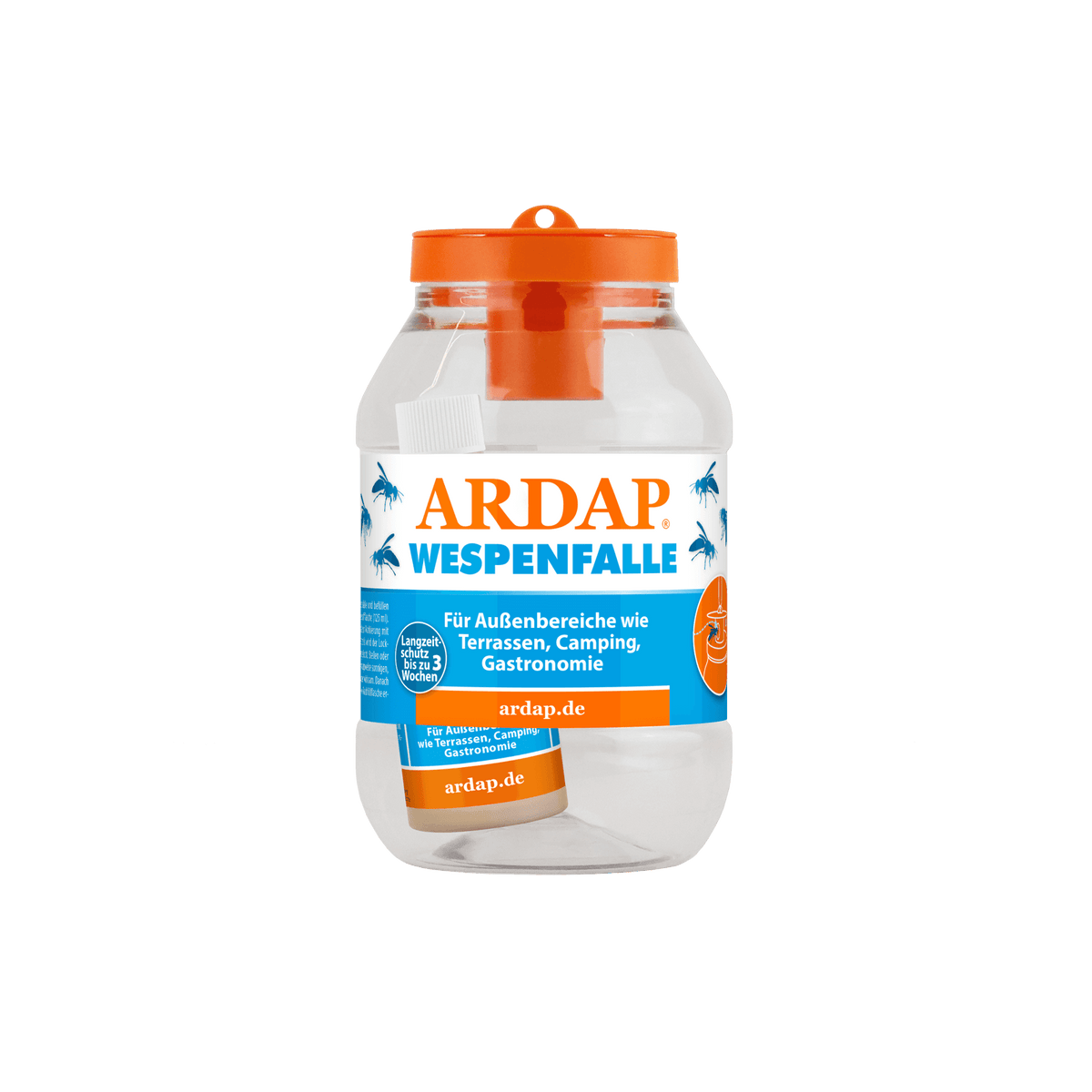
If action must be taken against the German wasp and the common wasp (aggressive subspecies of the true wasp) for the reasonable reasons mentioned above, the ARDAP wasp trap can be used. It is equipped with a special attractant and offers long-term protection for up to three weeks. The traps with refills are suitable for outdoor areas such as a terrace or for camping.
The ARDAP wasp trap is used for quickly catching wasps that enter the interior of the container through the entrance opening, from which they cannot escape. As soon as the attractant loses its effectiveness, you can easily refill it. Make sure beforehand that there are no longer any live wasps in the container. To activate it, pour the entire contents of an attractant bottle into the container and fill it with water up to the mark.

Effective sprays
For the effective, highly effective control of the German wasp, the common wasp, and the Asian hornet (from the subfamily of true wasps), in case of threat, the ARDAP Pro wasp foam spray and the ARDAP Pro wasp powerspray are two professional, scientifically proven solutions available, which are also used by pest control professionals.

The ARDAP Pro wasp foam spray is particularly suitable for hard-to-reach places and cavities and is equipped with a practical 2-in-1 spray head. The decisive advantage here is the spray tube, with which even roller shutter boxes or areas behind paneling can be reached. The product works immediately and leaves an effective barrier of up to 2 weeks in weather-protected areas. With this product, German wasps and common wasps and their nests can be controlled, provided this is permitted according to the reasonable reasons mentioned above. The product is also proven effective against Asian hornets.

The ARDAP Pro wasp powerspray offers a spray range of up to four meters. You benefit from a large distance that you can maintain from the aggressive insects. An advantage that makes this spray particularly stand out in use compared to other products. It works immediately and ensures a fast and lasting removal of wasps for up to 2 weeks. This spray can be used outdoors, on the terrace or balcony, and can control wasps and also far away nests high up on the house roof.
Conclusion
The subfamily of true wasps includes many different genera and species. Generally, these wasps are useful and important for our ecosystem. In particular, the German wasp and the common wasp are very common. However, these species can also pose a serious problem, as they quickly become aggressive. The Asian hornet is also increasingly widespread in our country. If you have to do with one of these three pests, control may be tolerated and in the case of the Asian hornet even professionally necessary. ARDAP helps with solutions that have also proven themselves in practical use by pest control professionals.
ARDAP Repell offers you an effective spray for deterring wasps. With the ARDAP Pro series, highly effective products are available for targeted control, which can make a contribution to danger prevention if reasonable, verifiable reasons exist. We recommend seeking the advice of an expert or a pest control professional before use.
Frequently Asked Questions
Which true wasp is the most aggressive?
In Germany, in addition to the German wasp (Vespula germanica), the common wasp (Vespula vulgaris) is considered the most aggressive species:
- It defends its nest particularly vigorously
- Becomes very intrusive during food searches in late summer
- Stings faster than other species
- For comparison: European hornets are significantly more peaceful
What do true wasps look like?
Typical characteristics of true wasps:
- Black-yellow warning coloration (striped pattern)
- Slender body structure (in contrast to hairy bees)
- Size: 10-20 mm (workers)
- Special characteristics of individual species:
- German wasp: 3 black dots on the head shield
- Common wasp: Anchor-shaped marking on the head
- Saxon wasp: Slender, with long hind legs
- Eur. hornet: Very large (up to 35 mm), reddish-brown body and head
Is the Saxon wasp dangerous?
No, the Saxon wasp (Dolichovespula saxonica) is harmless:
- Very peaceful (hardly stings)
- Useful: Eats harmful insects
- Shy: Avoids humans
- Only dangerous in case of allergies or stings in the mouth/throat
Can true wasps be controlled?
Of the true wasps, only the German wasp and the common wasp may be controlled in exceptional cases, if there is a compelling reason for this, which must also be verifiable.