Our expert Prof. Dr. med. vet. Norbert Mencke shows you interesting facts about hornets and informs you about the proper way to deal with these insects.
- Which hornets live in Germany?
- What does a hornet look like?
- What do hornets eat?
- How big are hornets?
- When do hornets build their nest?
- How far do hornets fly from the nest?
- How long do hornets live?
- What causes hornets to die?
- What to do about hornets?
- Conclusion
Which hornets live in Germany?
The European hornet (Vespa crabro) belongs to the subfamily of true wasps (Vespinae) and lives in forests and settlements in Europe. For a long time, this was the only species of hornet native to our country. The Asian hornet (Vespa velutina), which has recently also appeared here, poses a threat due to its high level of aggression and its impact on the local ecosystem.
The common wasp (Dolichovespula media), on the other hand, is not a true hornet, even though it is often referred to as a "small hornet" due to its physical similarities.

The European hornet
The European hornet is not dangerous to us humans and is considered a peaceful insect hunter in gardens and, more importantly, in our forests. The buzzing sound of this large insect can seem threatening to some people. However, its stings are no more dangerous than those of a wasp or bee. This species of hornet builds above-ground nests and is active day and night. When people approach, it usually flees.
Because its population is acutely threatened, the native European hornet is strictly protected. It is forbidden to kill these animals or remove their nests. If a nest is located in a problematic area, it may only be relocated by a professional with special permission from the relevant authority responsible for nature conservation.

The Asian hornet
The Asian hornet is assessed very differently from the European hornet. Unlike the protected native hornet, the Asian hornet is an invasive species, i.e., a non-native species from Asia that has entered our ecosystem. It causes ecological and economic damage in our country.
It is particularly dangerous to honeybees and wild bees, as it specifically hunts near beehives. It actively besieges the entrances to beehives and snatches bees coming in and out. It also attacks the European hornet (Vespa crabro), which further weakens the native ecosystem.
In addition to threatening insects, the Asian hornet also damages fruit and wine cultivation. Due to these dangers, the Asian hornet may be professionally controlled and its nests removed.

What does a hornet look like?
Hornets stand out not only because of their sheer size, but also because they are marked differently from wasps. The two species found in our country are visually distinct and therefore easily distinguishable at first glance.
The European hornet
The body of the European hornet generally has a reddish-brown color with black and yellow markings, while the head shield is exclusively yellow. The head, thorax, legs, and antennae of this species, however, are reddish-brown.
The Asian hornet
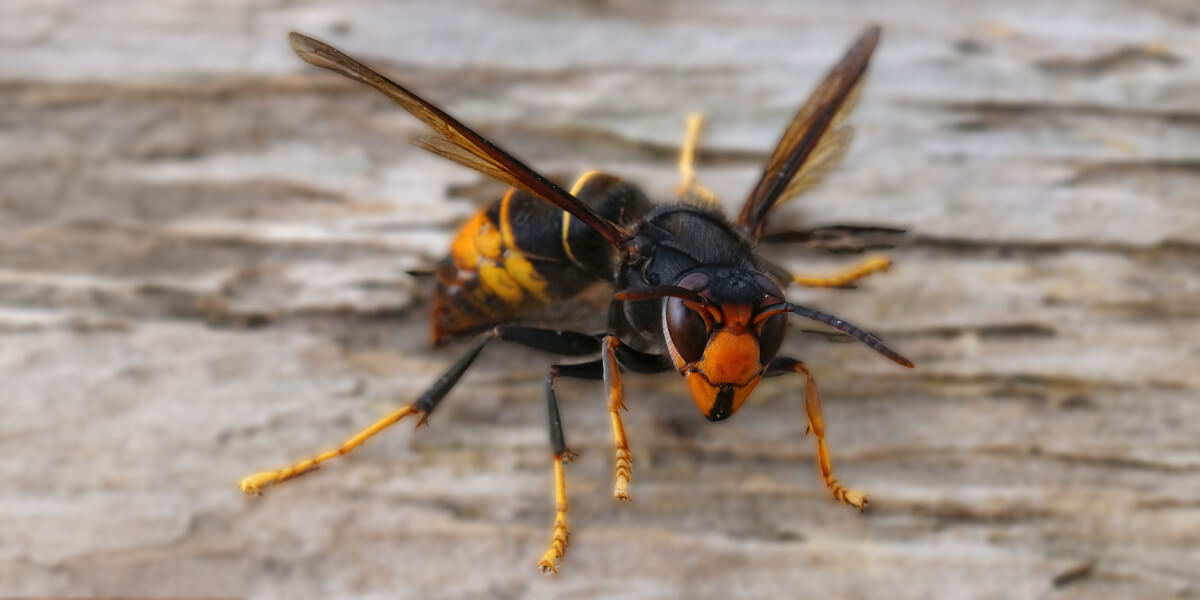
The head of the Asian hornet is entirely black, while the head shield is yellow to reddish-brown. Overall, these animals have a black base color, which clearly distinguishes them from both the European hornet and other wasps. The Asian hornet can be clearly identified by its legs: the upper leg segments are dark, while the lower ones are bright yellow.

What do hornets eat?
Differences can also be observed in the feeding habits of the two hornet species. In addition, the adult animals and the larvae each exhibit their own feeding behavior.
The European hornet
The European hornet plays an important role in our ecosystem. It exhibits balanced feeding behavior, which makes it a valuable beneficial insect. As an opportunistic hunter, it mainly preys on flies, horseflies, wasps, caterpillars, and spiders, thus contributing significantly to natural pest control. Contrary to popular belief, honeybees only make up a small part of its prey. The workers chew the captured insects into a nutritious, protein-rich paste, which they feed to the larvae.
For its own energy needs, the hornet uses various sugar-containing sources. It laps up tree sap leaking from oaks or ash trees, collects nectar from flowers, and feeds on overripe fallen fruit.
The Asian hornet
The Asian hornet has developed an extremely efficient hunting technique: It positions itself in front of beehives and specifically targets incoming and outgoing bees, whereby it can prey on up to 50 bees per day. But honeybees are not the only ones to fall victim to the Asian hornet. Wild bees, bumblebees, and other pollinating insects are also on the menu for the larvae, which are fed this protein-rich food by the workers.
In addition to its predatory lifestyle, the Asian hornet also causes considerable damage in agriculture. To cover its own energy needs, it specifically searches for ripe fruit such as grapes, pears, and apples, which it bites into, thereby making them susceptible to pest infestation. Winegrowers also complain about massive damage in their vineyards.


How big are hornets?
Hornets are generally quite large insects. When they fly toward you, they therefore always have a certain threatening effect.

The European hornet
In this species, the queen reaches a length of 35 millimeters, while the workers are only 18 to 25 millimeters long. The males (drones) are slightly larger than the workers. They measure 21 to 28 millimeters. For comparison: even the workers are almost twice as large as the German wasp.
The Asian hornet
The Asian hornet is slightly smaller than the European hornet. The queen reaches 30 millimeters and the workers 17 to 24 millimeters. The males (drones) are approximately the same size as the workers.

When do hornets build their nest?
Hornets begin building their nest in spring and establish their new colony. But even here, there are again subtle differences between the individual species.
The European hornet
The European hornet begins building its nest from late April to early May. For this purpose, it looks for, for example, a tree cavity or a roof or nest box. In these cases, the nest is cylindrical and evenly wide, with the entrance located on the underside of the nest. Rarely, it also builds its nest in the ground. It does not move again later; the nest continues to grow. The maximum size is reached in August or September, with 400 to 700 individuals. This species only builds a single nest with a width of about 30 centimeters and a height of up to 60 centimeters.
The Asian hornet
The Asian hornet can begin building its nest as early as late February. Unlike the European hornet, it builds several nests and can thus significantly increase the size of its colony. First, the young hornet queen builds a small embryonic nest, in which she incubates the first eggs and feeds the larvae alone. As soon as enough workers have hatched, the primary nest is built and they move there. They stay here until the hornet colony reaches a stately size of 1,000 or more insects in midsummer. Now the pear- or ellipse-shaped secondary nest is built. Secondary nests have a side entrance and can reach a height of up to one meter. Overall, the Asian hornet colonies then grow to over 6,000 individuals.

How far do hornets fly from the nest?
Do hornets fly far from their nest or do they always stay in its relative vicinity? The answer also depends on which hornet species we are looking at.
The European hornet
Generally, the flight paths of the workers are between 500 and 1,000 meters[1]. However, significantly greater distances have also been documented. For example, there are said to be individual flights of over three kilometers. Here it should be considered that the European hornet is stronger and more robust than the Asian hornet and can therefore cover longer distances.
The Asian hornet
The flight distances of the Asian hornet are slightly shorter than those of the European hornet. Typical flights are about 400 meters. A maximum of up to 800 meters can be expected for this species. However, even here, significantly greater flight distances of over one kilometer are possible in exceptional cases, for example when the animals are artificially released[2].
How long do hornets live?
Since hornets have a one-year colony cycle, no individual lives longer than one year. Differences arise between the queens, workers, and drones, and between the European and Asian hornets.
The European hornet
The queen of the European hornet has a lifespan of nine to twelve months, including hibernation. The workers, on the other hand, live only about three to four weeks. The life expectancy of the males is slightly shorter. They die after only two to three weeks.
The Asian hornet
The lifespan of the Asian hornet queen is about eight to ten months. Workers of this species live for 30 to 55 days, and the drones for less than three weeks.
What causes hornets to die?
What do hornets actually die from? Here we answer the question for you.
The European hornet
The natural seasonal death occurs in this species with the first hard frost. It is also possible that the hornets are eaten by other animals or succumb to disease or parasites. Internal fights with foreign workers from another hornet colony are also possible. Please note that the native hornet is a beneficial insect that should be protected. Because this species hunts pests and contributes to the pollination of plants.
The Asian hornet
The Asian hornet dies like the European hornet from seasonal death. The colony dies from prolonged frost as well as from food shortages in winter. Diseases and parasites as well as natural predators can also play a role. Please note that the Asian hornet sees native insects, especially hornets and bees, as prey and threatens the colonies. And it damages fruit and wine cultivation. It is therefore quite sensible to professionally control this predatory species to protect our native ecosystem.

What to do about hornets?
Hornets appear in your garden and you wonder what to do now? We provide you with the answer.
The European hornet
In principle, it is forbidden under the Federal Nature Conservation Act[3] to catch, kill, or destroy the nests of wasps and European hornets without a reasonable reason. The native European hornet is explicitly listed in the Federal Species Protection Ordinance[4]. Control of this species is generally forbidden and is also unnecessary, because these hornets pose no danger to us. They are often not even a nuisance, because they normally do not go after our sweet or protein-rich foods. We can therefore usually stay undisturbed on the terrace or balcony when these hornets are nearby.
The Asian hornet
The situation with the Asian hornet looks completely different compared to the native species. This species, which actually originates from Asia, is considered invasive in our country, and here professional control is permitted and also necessary. These hornets behave aggressively when we approach their nest. Proven products from specialist retailers are therefore used by pest control professionals.
The ARDAP Pro Wespen Schaumspray provides a highly effective remedy for the quick and reliable control of the Asian hornet as well as the common and German wasp. Thanks to the practical 2-in-1 spray head, the spray can be applied both over large areas on surfaces and sprayed directly into hard-to-reach nests.
The ARDAP Pro Wespen Powerspray is designed for the quick and reliable control of Asian hornets from a distance of up to 4 m. The proven spray ensures a quick and lasting elimination for up to 2 weeks and can be used in outdoor areas such as terraces, balconies, or under the eaves of houses and garden sheds.
Conclusion
It is important to distinguish between the different species of hornets. The European hornet is a native species. It acts as a beneficial insect and is therefore specially protected. The Asian hornet, on the other hand, can threaten health and weaken the ecosystem, which is why professional control is required. This is exactly where ARDAP Pro also helps pest control professionals in the control of Asian hornets.
Sources
- MPDI – A review of Five Existing Hornet-Tracking Methods
- National library of Medicine - Activity rhythm and action range of workers of the invasive hornet predator of honeybees Vespa velutina, measured by radio frequency identification tags
- Federal Nature Conservation Act
- Federal Species Protection Ordinance