- What is the Common Tick? Fact Sheet
- Feeding
- Distribution and Occurrence of the Common Tick
- Who is at Risk from the Common Tick?
- How to Protect Dogs and Cats from Ticks
What is the Common Tick? Fact Sheet
When discussing ticks in Germany and Europe, we are usually referring to the common tick. It is particularly widespread here and poses a health risk to humans and animals such as dogs and cats.
Fact Sheet
- Zoological name: Ixodes ricinus
- Belongs to the class of arachnids (Arachnida)
- Most common representative of the hard ticks
- Significant tick species in Central Europe
- Identifies hosts using Haller's organ, e.g. through scents
- Acts as a vector (carrier and transmitter) especially for tick-borne encephalitis (TBE) and Lyme borreliosis
- Can lay up to 3,000 eggs
How to Identify the Common Tick
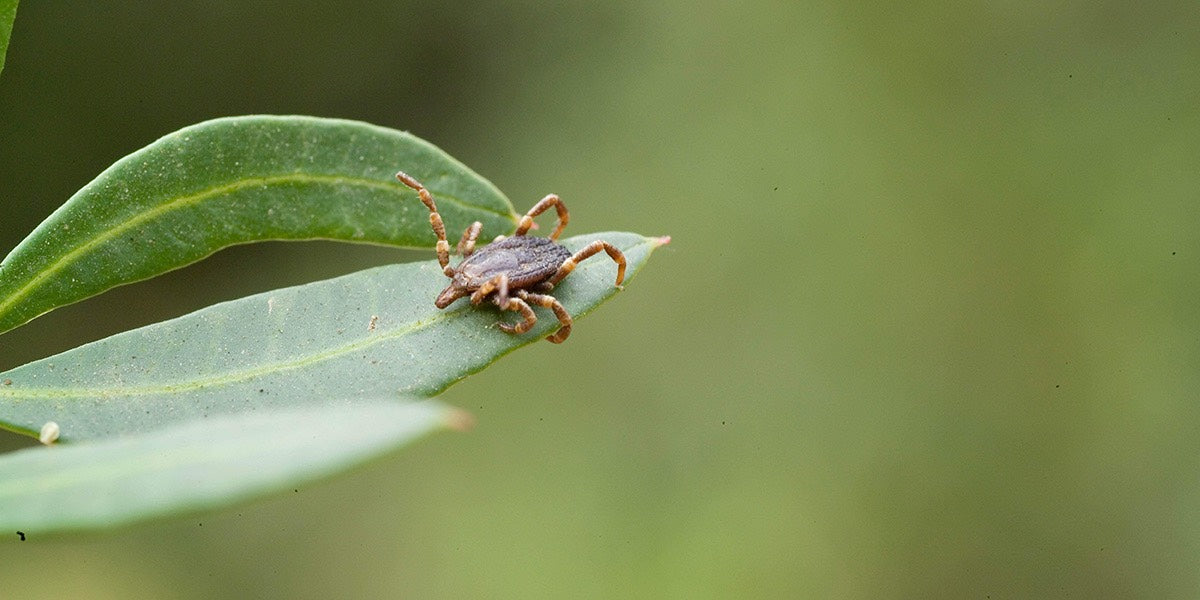
Adult ticks are easily mistaken for small spiders at first glance. In males, the body is completely covered with a dark shield on the back. This sturdy chitinous shell is less developed in females, which also show a reddish-brown colour. They are therefore usually easy to spot on light-coloured clothing.

Characteristics and Body Structure of the Common Tick
In general, the common tick has a body typical of arachnids. It is divided into a forebody and abdomen. Both parts are relatively strongly fused together. The mouthparts are located on the forebody, which in this genus have been adapted into a piercing apparatus with barbs. The parasites store the host's blood in their highly elastic abdomen.
An adult tick measures up to 2.8 millimetres in the case of males and up to 4.0 millimetres in the case of larger females. If it is a fully engorged tick, even up to 10 mm is possible. In larvae, nymphs and unengorged females, a protective chitinous shield covers half the body, and in males, the entire body. Characteristic features of the common tick are its sack-like shape, i.e. an oval body, and its forward-facing mouthparts. The colour ranges from steel grey to light reddish-brown.
Development of the Common Tick
The adult female tick falls off the host animal after feeding on blood and mating, begins to lay eggs in a suitable place, and then dies. After about one to four weeks, six-legged larvae hatch from the eggs. How quickly this happens depends on the environmental conditions, e.g. temperature and humidity. The larvae usually choose smaller host animals to feed on. After that, they develop into eight-legged nymphs in the environment. These then also prefer larger mammals as hosts. This includes, for example, rodents or birds. However, larvae and nymphs can also infest our pets and us humans. After feeding on blood from these larger hosts, the nymph falls off the host and molts into an adult tick in the environment. The adults then search for a third host for their final blood meal.

Feeding
Ticks need host animals so that they can take their so-called blood meal. The common tick is a three-host tick, i.e. larvae, nymphs and adult ticks need a new host. They choose a suitable spot on the host animal, cut open the skin with their mouthparts, and then sting. The common tick's blood meal can last for several days. Adult females have been proven to remain firmly attached to the host animal for up to 14 days.
Ticks develop from larvae into nymphs and then into adults after another blood meal. Among adult ticks, only the females take a blood meal; sexually mature males no longer feed. This development can take a total of one to two years. Ticks can survive without taking blood for up to one year.
Distribution and Occurrence of the Common Tick
The common tick occurs almost everywhere in Europe, and thus also in Germany. We have looked at where the distribution areas are and give you tips on where you need to pay particular attention in your private surroundings.
The Common Tick in Germany
The common tick can be found practically everywhere in Germany. It lives in forests and at the forest edge, as well as in parks, gardens, and wasteland. This means ticks are everywhere we humans stay, but also our dogs and cats. In gardens and forests, ticks also find many other host animals for their blood meals. These include, for example, mice or birds that forage on the ground, as well as hedgehogs. Seasonally, the common tick occurs in larger numbers mainly from March to October. However, a typical tick season cannot be identified with the common tick either - thanks to the mild winters, ticks are now active all year round. As a pet owner, you should therefore always ensure year-round tick protection.


The Common Tick in Europe
The common tick has its distribution area throughout Central Europe. Its natural habitat only ends in northern Scandinavia and otherwise extends from Eastern to Western Europe, and thus across almost all European countries. When we look at the Mediterranean regions, we find this tick species mainly in the higher-altitude deciduous or mixed forests.

Who is at Risk from the Common Tick?
In general, the common tick is dangerous to our pets and also to humans. It can carry pathogens that are transmitted during a sting. Here you will find out everything important about this.
Which pathogens does the tick transmit?
The common tick can transmit various pathogens, which include especially borrelia and the pathogens of FSME (tick-borne encephalitis, better known as meningitis). This is a reportable infectious disease in humans. FSME is particularly widespread in Central and Eastern Europe and in Germany increasingly in Baden-Württemberg, Bavaria, southern Hesse, southeastern Thuringia, Saxony, and southeastern Brandenburg (Source: RKI). However, there is a risk of infection throughout Germany.
Lyme borreliosis, on the other hand, is widespread throughout Central Europe. About every fifth tick in Germany is infected with the pathogens of borreliosis, which live in the parasites' intestines.
Risks to Humans
In humans, FSME can lead to a severe course of illness, with inflammation of the brain, meninges, or spinal cord. Complications can occur especially in seniors, who therefore must be particularly careful. Long-term consequences after surviving FSME are also possible, with headaches, concentration problems, and other symptoms.
The treatment of borreliosis is carried out with antibiotics. If this is omitted, various follow-up illnesses can occur, including chronic inflammation or heart problems. The probability of this is, however, rather low. Only a few people actually fall ill with borreliosis after a tick sting. Whether a transmission of borrelia occurs also depends on how quickly the tick is detected and removed from the skin.

Risks to Dogs and Cats
Ticks can pose a real health risk for dogs and cats. Borrelia infections have also been described in many animals, including dogs and cats. In dogs, painful arthritis can develop. Other symptoms are fever, general malaise, or alternating lameness. It is entirely possible that a corresponding course of illness only develops after months. Therefore, it is so important to act quickly and to remove ticks immediately.
Caution is also advised for dogs with regard to FSME. In animals, neurological symptoms and fever can occur, for example. Therefore, you should check your dog for ticks after spending time outdoors. Although no clinical symptoms of FSME have been described for cats, outdoor cats should also be checked regularly for ticks and protected from ticks all year round.
How to Protect Dogs and Cats from Ticks
There are many options for protection against tick infestation. Several products follow that you can apply directly to the animal to protect it from infestation by the common tick as well as other native tick species. Always keep in mind that prevention is better than cure, which otherwise can be necessary and prolonged when a disease breaks out.

Collar
The ARDAP Tick Collar for Cats and the ARDAP Tick Collar for Dogs with the active ingredient pyrethrum from chrysanthemums provide a simple way to protect your pet from tick infestation. The loose attachment and adjustment around the neck are sufficient, and you get long-lasting protection for up to four months.

Spot-On
The ARDAP Tick Spot-On for Cats or the ARDAP Tick Spot-On for Dogs offers highly effective protection against ticks and also fleas. This lasts up to twelve weeks per package. The product is intended to be dripped onto the skin in the neck area. The active ingredient distributes itself over the natural skin oil film and provides a repellent, i.e. repelling, protection against ticks.
Tick Spray
The ARDAP Tick Spray is sprayed onto the fur until it is slightly damp. Pyrethrum and lavender oil ensure immediate tick protection, which reliably keeps the parasites away for up to four weeks.


Tick Powder
With the ARDAP Tick Powder for Dogs & Cats you get a product that you can apply quickly and easily to your pet. It is intended to be sprinkled into the fur and contains pyrethrum and lavender oil. The repellent effect takes effect immediately and then lasts for one week. In addition to ticks, this product also protects against other pests such as fleas and mites.

Tick Shampoo
The ARDAP Tick Shampoo for Dogs offers another way to create effective protection against ticks. You simply need to gently rub the product into the dog's fur. This product is uncomplicated to use and simultaneously cares for and cleans the dog's fur.