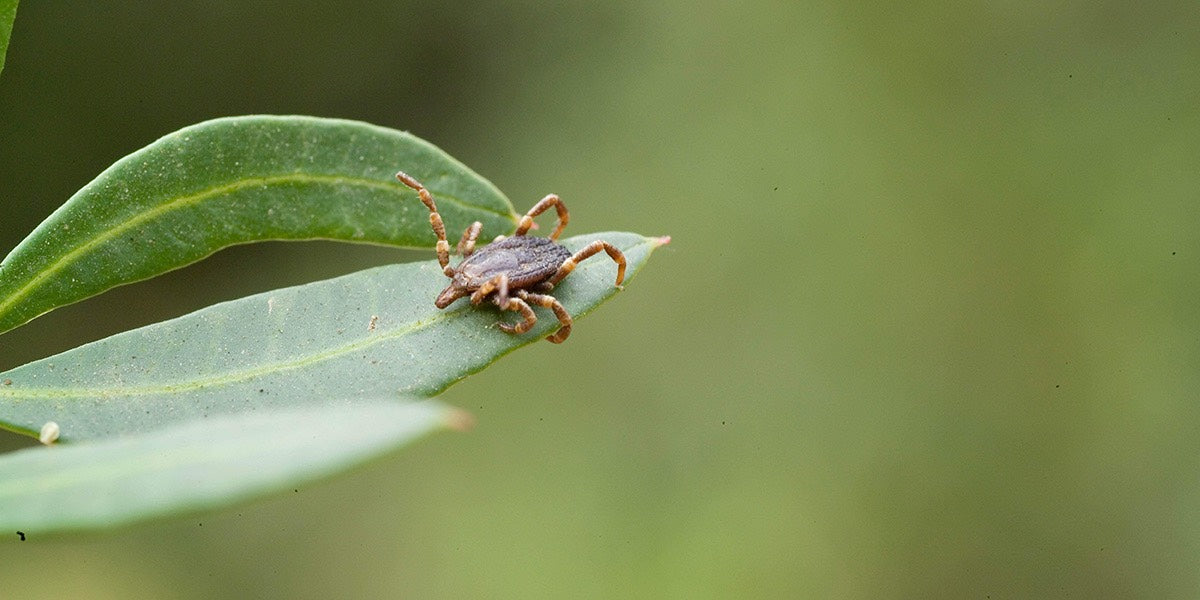
Together with our expert Prof. Dr. med. vet. Norbert Mencke, a specialist veterinarian in parasitology, we explain which ticks are found in Germany, how dangerous these tick species are, and what you can do to protect yourself and your pets from tick bites and diseases.
- Can ticks transmit pathogens?
- Preventing ticks on dogs and cats
- Removing ticks
- How many tick species are there?
- Which tick species are found in Germany?
- White, red, black tick – what do the colors mean?
- Tick species compared
- What new tick species are there?
- What is the deal with the flying tick?
- Conclusion
- Frequently asked questions
There are around 20 tick species in Germany, including the common wood tick, the woodland tick, and the brown dog tick.
Due to climate change, new tick species such as the Hyalomma tick and the brown dog tick are spreading in Germany.
Almost all ticks can transmit dangerous pathogens such as Borrelia (Lyme borreliosis) and FSME viruses to humans, dogs, and cats and make them ill.
Effective protection for pets is possible with the ARDAP tick collar or the ARDAP Spot-On, which work as a repellent for several weeks.
Additionally, ARDAP tick powder, ARDAP tick spray and ARDAP anti-tick shampoo can enhance protection for dogs.
Attached ticks should be removed as quickly and correctly as possible using reliable tools such as the ARDAP tick hook or the ARDAP tick tweezers, without squeezing or twisting the tick's body.

Can ticks transmit pathogens?
Almost every tick species can transmit pathogens that can make humans, dogs, and cats ill. The best-known are Borrelia (the pathogen of Lyme borreliosis) and FSME viruses, the causes of spring-summer meningoencephalitis (FSME). Humans can be vaccinated against FSME, but not against Lyme borreliosis. However, Lyme borreliosis is very well treated and curable if detected early enough.
The most important and well-known early warning sign is the so-called erythema migrans, which develops around the tick bite site a few days later. However, the absence of erythema migrans is no guarantee that Borrelia has not been transmitted. The pathogens may still have been transmitted. In the descriptions of the individual tick species and the tick table , we point out other pathogens that can be transmitted from ticks to humans, dogs, or cats.

Preventing ticks on dogs and cats
With the help of the ARDAP tick collar for cats or the ARDAP tick collar for dogs, we can reliably prevent tick infestations on our pets. As an alternative, the ARDAP Spot-On for dogs or the ARDAP Spot-On for cats are also suitable. Both the collar and the Spot-On use pyrethrum from chrysanthemum flowers and thus act as a repellent against ticks. The Spot-Ons contain 3 tubes and thus provide long-lasting protection against ticks for up to 12 weeks in total. The tick collars provide protection against ticks for up to 4 months.


As a supplement to Spot-On and Collar, the ARDAP tick powder and the ARDAP tick spray can also be used. For dogs, it is also recommended to clean and care for the coat with the ARDAP anti-tick shampoo, which acts as an additional repellent protection. The listed products are particularly suitable as a supplement when the probability of a tick infestation is high, for example, if you plan to walk through tall grass, dense forest, or into the dog park or the park. Even if you plan to go on vacation and your holiday destination is a pronounced tick area, you can supplement both the Spot-On and the collar with spray, powder, and shampoo to protect your pet perfectly all around.

Removing ticks
If a tick has already attached itself because you did not take preventive measures with repellent products, you need the right tool to remove the tick. The ARDAP tick hooks, which you can conveniently attach to a keychain or leash, or the 2 in 1 ARDAP tick hook with tweezers in a high-quality case are ideal for this.
It is important to remove the tick as early as possible. Ticks are pulled out slowly and evenly. With the tick hook or tweezers, you should grasp the tick as close to the animal's skin as possible, directly behind the head, not on the tick's body. This prevents the squeezing of the tick's body, which could push already absorbed body fluids – and thus pathogens – into the host's skin and blood.


How many tick species are there?
By now, around 650 tick species found worldwide are known, around 20 of which are also found in Germany.
Tick species in Germany at a glance:
- Common wood tick (Ixodes ricinus)
- Hedgehog tick (Ixodes hexagonus)
- Fox tick (Ixodes canisuga)
- Woodland tick or mottled tick (Dermacentor reticulatus)
- Sheep tick (Dermacentor marginatus)
- Hyalomma tick
- Relict tick (Haemaphysalis concinna)
- Brown dog tick (Rhipicephalus sanguineus)
Most ticks belong either to the hard ticks with a hard dorsal shield or the soft ticks, which have a soft, leathery body. While the robust hard ticks feel comfortable almost everywhere, soft ticks live mainly in tropical and subtropical regions. Of the tick species native to Germany that infest our dogs and cats, as well as us humans, almost all of them also belong to the hard ticks. The only soft tick that is also found here and is harmless to dogs and cats is the pigeon tick.

Which tick species are found in Germany?
The best-known and most common tick species in Germany is the common wood tick. In addition, various more or less dangerous tick species have established themselves here; others are on the rise – mainly due to weather and climate conditions. Here we briefly introduce the most important tick species living in Germany with their special features. More details can be found below in the tick species overview.
Common wood tick
The common wood tick (Ixodes ricinus) is widespread throughout Germany and Europe. It lives in forests, but also on meadows, in gardens, and in parks. Due to climate change, more recent studies have also detected the wood tick at altitudes above 1500 m. These ticks have no eyes and can neither jump nor actively hunt. Instead, they climb onto grass blades and low plants, where they lie in wait and wait for a suitable host to pass by and brush them off.
Like other eyeless tick species, the common wood tick detects animals and humans whose blood it can suck by their body heat, vibrations, moisture, shadows, and volatile substances such as CO2 in the exhaled air. It is not picky when choosing a host; in addition to dogs, cats, and humans, it also bites deer, red deer, foxes, hedgehogs, rodents, and birds. It can transmit the pathogens of Lyme borreliosis and spring-summer meningoencephalitis (FSME), which is why a so-called tick vaccination (against FSME) is recommended for humans in risk areas. Important!: The vaccination is aimed at the FSME virus and has no effect on the tick.
The common wood tick is very well adapted to the seasons, including cold winters. Therefore, tick protection is an all-year-round topic for pet owners.
Hedgehog tick
The hedgehog tick (Ixodes hexagonus) is also called the white tick because of its strikingly light to white color. It prefers to stay in the burrows and nests of its host animals (e.g. hedgehogs), but can also infest free-roaming cats and dogs in forests and gardens. Like other native ticks, it can transmit FSME viruses and Borrelia; however, humans are rarely bitten by hedgehog ticks.
Fox tick
The fox tick (Ixodes canisuga) looks so similar to the common wood tick that laypeople can hardly distinguish them with certainty. Dogs are bitten very often by this tick species, but cats and humans only rarely. Its main host is the red fox. Like hedgehog ticks, fox ticks prefer to stay in burrows and nests. As a nidicolous (nest-dwelling) tick species, it also needs a host that lives in a burrow or underground den for reproduction. Fox ticks can transmit Borrelia and Babesia.

Woodland tick or mottled tick
This tick species (Dermacentor reticulatus) is also known as the meadow tick or winter tick and displaces Ixodes ticks. It is found in forests and meadows in southern and eastern Germany. But it can also be found near cities, e.g. on dog walking areas. The woodland tick is dangerous for dogs and cats because it can transmit the pathogen of babesiosis. Humans are bitten by the woodland tick less frequently.
Sheep tick
The sheep tick (Dermacentor marginatus) is adapted to dry locations and the presence of sheep flocks. Like the Hyalomma tick, it is often referred to as a “new tick species”. It prefers dry, warm habitats and is found mainly on meadows and pastures. This tick species is dangerous for dogs and humans because sheep ticks can transmit pathogens of Q fever, Rocky Mountain spotted fever, and Siberian tick bite fever, and infect dogs with babesiosis or tularemia (“rabbit fever”).
Hyalomma tick
The Hyalomma tick is also called the giant tick because of its impressive size and lives mainly in Africa. Through migratory birds, it also reaches Germany, where it is found more and more frequently. Unlike most hard tick species, it has eyes, so it can actively hunt and pursue host animals up to 100 m away. It also needs hardly any water and is therefore significantly more robust against dryness than, for example, the common wood tick.
According to current knowledge, this tick species is hardly dangerous for dogs and cats. It could transmit pathogens of Crimean-Congo hemorrhagic fever and other dangerous infectious diseases to humans.
Relict tick
The relict tick (Haemaphysalis concinna) has so far only been found occasionally in Germany. It is therefore not yet clear whether it will establish itself here permanently. It differs from the common wood tick with its smooth, dark shell by a lighter, furrowed dorsal shield.
Brown dog tick
The Brown Dog Tick (Rhipicephalus sanguineus) is, like the Hyalomma tick, a predatory tick. Having migrated from Africa, this tick species has now reached Germany via Southern Europe. It mainly bites dogs, which it can endanger as a potential carrier of Babesia and other pathogens (including Ehrlichia and Anaplasma). Cats and humans are bitten much less frequently. A special feature of the Brown Dog Tick is that it feels comfortable in heated rooms and can therefore overwinter, for example, in animal shelters or homes.
White, red, black tick – what do the colors mean?
In the Common Wood Tick, by far the most common tick species in Germany, the unengorged females (i.e., before their blood meal) are reddish to brown with a dark to black dorsal shield. The males are smaller and look rather black because the shield covers the entire back. In fully engorged females, the highly stretched body has a gray color. Some tick species such as sheep ticks or marbled ticks look "more colorful" because they have, for example, marbled shields or light striped legs. Dog ticks are uniformly brown to reddish-brown, while hedgehog ticks are conspicuously light, which is why they are also called "White Ticks".
Regardless of the respective coloration, however, the rule is: Every tick should be removed as quickly as possible and the bite site carefully observed for several days afterwards. If redness, inflammation, or other skin changes appear there, you should go to the doctor and, for example, get tested for Lyme disease antibodies and be treated if necessary. The same applies if the dog or cat develops severe skin reactions after a tick bite, becomes ill, or shows altered behavior.
Comparison of tick species
Latin name: Ixodes ricinus
Appearance/Identifying features: Small, brown, flat body profile
Size of adult female unengorged/fully engorged: 1.5 - 3 mm / 3 - 10 mm
Frequency: Very common
Transmissible pathogens: Lyme disease (humans, dogs, cats, horses) FSME (humans, dogs)
Special features: Ambush predator (no eyes); reduced activity in heat/drought
Latin name: Ixodes hexagonus
Appearance/Identifying features: White color, initially very small
Size of adult female unengorged/fully engorged: 1 - 2 mm / 2 - 4 mm
Frequency: Common
Transmissible pathogens: Lyme disease (humans) FSME (humans, dogs)
Special features: Ambush predator; prefers living in buildings; often infests free-roaming cats
Latin name: Ixodes canisuga
Appearance/Identifying features: Similar to Common Wood Tick
Size of adult female unengorged/fully engorged: 1.5 - 3 mm / 3 - 10 mm
Frequency: Common
Transmissible pathogens: Lyme disease (humans) Babesiosis (dogs, cats)
Special features: Ambush predator; associated with nest- and building-dwelling species
Latin name: Dermacentor reticulatus
Appearance/Identifying features: Marbled dorsal shield, significantly larger than Wood Tick
Size of adult female unengorged/fully engorged: 3 - 5 mm up to 16 mm
Frequency: Increasing, depending on weather
Transmissible pathogens: Babesiosis (dogs) Lyme disease (dogs); Rickettsiosis (cats, dogs)
Special features: Ambush predator; also active at low temperatures; bites humans only rarely
Latin name: Dermacentor marginatus
Appearance/Identifying features: Relatively large tick species, conspicuously colorful pattern
Size of adult female unengorged/fully engorged: 2 - 5 mm / up to 15 mm
Frequency: Increasingly common
Transmissible pathogens: Q fever, tularemia, babesiosis, anaplasmosis (dogs, cats)
Special features: Has eyes; feels comfortable in warm, sunny, dry places; bites humans rather rarely
Latin name: Rhipicephalus sanguineus
Appearance/Identifying features: Brown body
Size of adult female unengorged/fully engorged: 2 - 4 mm up to 12 mm
Frequency: Common
Transmissible pathogens: Mediterranean spotted fever (humans) Babesiosis, ehrlichiosis, babesiosis (dogs) Anaplasmosis, tularemia (cats)
Special features: Survival in rooms possible, therefore year-round occurrence; also bites cats and (more rarely) humans
Latin name: Hyalomma marginatum and Hyalomma rufipes
Appearance/Identifying features: Very large, striped legs
Size of adult female unengorged/fully engorged: 3 - 6 mm / up to 20 mm
Frequency: Previously rare, but increasing
Transmissible pathogens: Tick spotted fever, Crimean-Congo hemorrhagic fever (humans)
Special features: Active hunter (has eyes); introduced by migratory birds; belongs to the new tick species; rather harmless for dogs and cats
Latin name: Haemaphysalis punctata / H. concinna:
Appearance/Identifying features: Medium to light brown dorsal shield
Size of adult female unengorged/fully engorged: 2.5 - 4 mm / up to 12 mm
Frequency: Very rare
Transmissible pathogens: Still under investigation
Special features: Only individual findings so far
Download tick species comparison as PDF
What new tick species are there?
Tick species such as the Hyalomma tick, sheep tick, or relict tick, which have either only recently become native to us or are not yet firmly established in Germany, are referred to as "new tick species". Often they have only been found individually and/or at locally limited hotspots so far. New tick species often settle first or primarily in Southern Germany, where the classic tick risk areas of the Common Wood Tick are located. Relict ticks have so far only been found in Brandenburg.

Research institutions such as the RKI (Robert Koch Institute), parasitologists and other experts keep an eye on the tick population in Germany and also investigate the danger potential of new tick species for animals and humans. For residents of the Wood Tick risk areas, a regular FSME vaccination for adults and children has been recommended for decades. Dog and cat owners should protect their animals from tick bites, for example with the ARDAP Tick Spot-On for cats or the Tick Spot-On for dogs. The animal should also be checked for ticks after every stay outdoors; this way the parasites can often be removed before they have attached or become fully engorged.
What's the deal with the flying tick?
Ticks can neither fly nor jump or climb trees. Most do not even have eyes and at most crawl on grass blades and low plants to wait for host animals there. When people talk about "flying ticks", they are usually referring to the Hirschlausfliege, another blood-sucking parasite, which is not related to the tick.
Conclusion
In Germany, various tick species such as the Common
Wood Tick, the Marbled Tick, or the Brown Dog Tick are widespread.
These can transmit dangerous pathogens such as Borrelia (Lyme
Borreliosis) and FSME viruses to humans, dogs, and cats
. New tick species such as the Hyalomma tick are also
on the rise.
To effectively protect pets from ticks, ARDAP offers a
range of highly effective products: The ARDAP
Tick Collar or the ARDAP Spot-On work as a repellent for several
weeks. In addition, the ARDAP
Tick Powder, the Tick Spray, or the Anti-Tick Shampoo for
dogs can be used. Should a tick nevertheless have attached due to a lack of
prevention, it is important to remove it
as quickly and carefully as possible to minimize the risk of
disease transmission. For this purpose, the ARDAP
Tick Hook or the ARDAP 2 in 1 Tick Pincer are suitable. Since ticks
are now active year-round, reliable prevention
with ARDAP Products throughout the year is recommended.
Frequently Asked Questions
Which ticks are the most dangerous?
How dangerous ticks are depends on the pathogens they transmit . Among the most dangerous ticks in Germany are generally the Common Wood Tick (carrier of Lyme disease and FSME), the Marbled Tick (can transmit babesiosis ), the Brown Dog Tick (carrier of Babesia, Ehrlichia, and Anaplasma). Therefore, year-round, reliable protection with repellent, highly effective products from ARDAP is essential for your pet, for example with the ARDAP Tick Collar or the ARDAP Spot-On for dogs or cats
What ticks are there in Germany?
Several tick species are native to Germany. The most important are the Common Wood Tick, Marbled Tick or Bunt Tick, Hedgehog Tick, Fox Tick, Brown Dog Tick, Sheep Tick, as well as recently also the Hyalomma tick (Giant Tick). Repellent products from ARDAP help against these ticks, such as the Spot-On or the Tick Collar.
What is the difference between a tick and a Wood Tick?
There is no difference between a tick and a Wood Tick, as "tick" is the general term for the entire parasite group. The Common Wood Tick is therefore a specific tick species – and by far the most common in Germany. This means that the "Wood Tick" is a tick, but not every tick is a Wood Tick.
What are the small black ticks called?
The small, black-looking ticks are often male Common Wood Ticks. Since their shield-covered body is hardly stretchable, they remain small and appear dark. The Brown Dog Tick is also relatively small and uniformly brown in its unengorged state. To remove them safely, the ARDAP Tick Hook or the ARDAP Tick Pincer are suitable.
How many tick species are there?
Approximately 650 tick species are known worldwide. In Germany about 20 species occur, with the Common Wood Tick being by far the most widespread tick species.
What is the new tick species called?
New tick species refer to all those ticks that are spreading in Germany due to climate change or newly establishing themselves. In addition to the Hyalomma tick, this also includes the Brown Dog Tick as well as the Sheep Tick.